

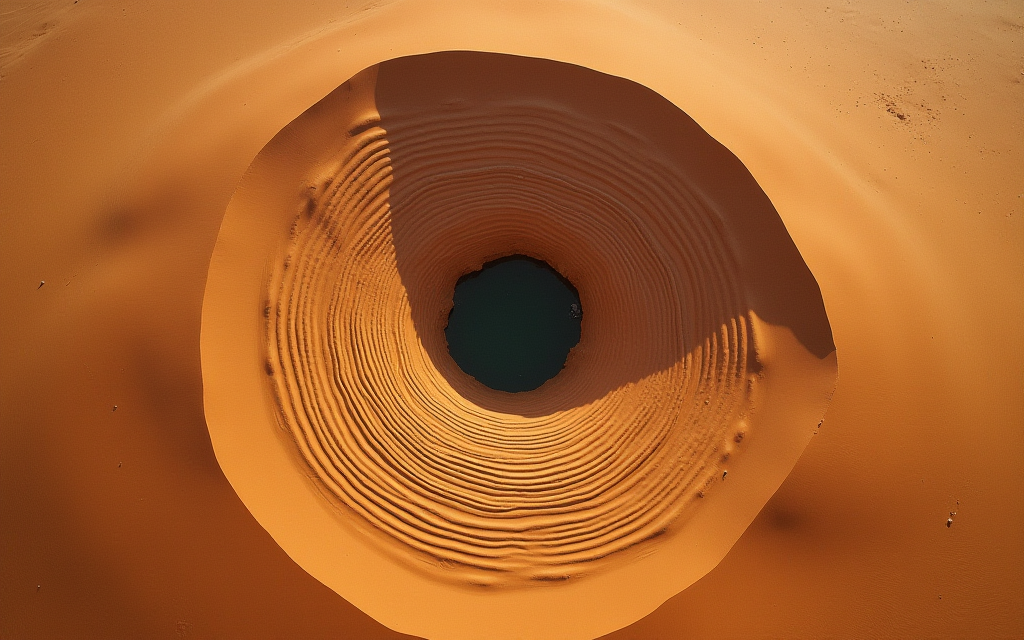
NASA Unveils Stunning Satellite View of the Eye of the Sahara
NASA has released a stunning satellite image of the Eye of the Sahara, a 40-kilometer-wide geological formation in Mauritania. Known as the Richat Structure, it is a deeply eroded dome that has fascinated scientists for decades. The image, captured by Landsat, reveals the intricate concentric rings of rock and provides insights into Earth's geological history.
NASA Unveils Stunning Satellite View of the Eye of the Sahara
NASA has released a breathtaking image of the Eye of the Sahara, also known as the Richat Structure, captured by satellite. This geological formation, located in the Adrar Plateau of Mauritania, has fascinated scientists and space enthusiasts for decades.
What Is the Eye of the Sahara?
The Eye of the Sahara is a prominent circular feature in the Sahara Desert, approximately 40 kilometers in diameter. It was initially thought to be an impact crater, but further study revealed it to be a deeply eroded geological dome.
The structure consists of concentric rings of rock, with a central peak. The rings are made of different types of sedimentary and igneous rocks, dating back to the Proterozoic era. The formation has been shaped by millions of years of erosion and weathering.
Scientific Significance
The Richat Structure is a valuable site for geological research. It provides insights into the tectonic history of the region and the processes of erosion. The rings expose layers of rock that are otherwise hidden beneath the desert sands, offering a window into the Earth’s past.
Additionally, the site has been used as a landmark for astronauts and has been featured in numerous satellite images. Its unique appearance has made it a popular subject for remote sensing studies.
NASA’s Observation
The image was captured by NASA’s Landsat satellite, which has been monitoring Earth’s surface for decades. The satellite’s high-resolution sensors reveal the intricate details of the structure, including the varying mineral compositions that give the rings their distinct colors.
NASA frequently shares such images to highlight the beauty and complexity of our planet. The Eye of the Sahara serves as a reminder of the dynamic geological processes that have shaped Earth over billions of years.
Public Fascination
The Eye of the Sahara has captured the public imagination, often appearing in discussions about extraterrestrial impact craters and ancient civilizations. However, scientists emphasize that it is a natural geological formation, not an artificial structure.
With NASA’s release of this image, the Eye of the Sahara continues to inspire awe and curiosity about the natural wonders of our world.
