

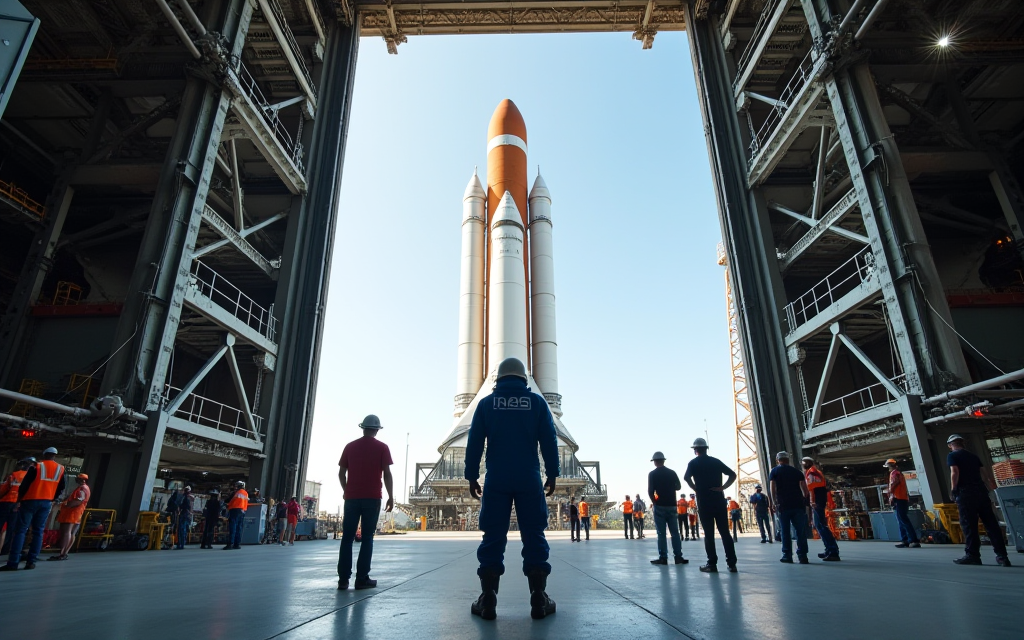
NASA Astronaut Andre Douglas Tours Vehicle Assembly Building Ahead of Artemis III Moon Mission
NASA astronaut Andre Douglas visited the Vehicle Assembly Building at Kennedy Space Center on Nov. 27, 2026, to inspect progress on the Space Launch System rocket and Orion spacecraft for the Artemis III mission. Douglas, a member of the crew, met with engineers and technicians as preparations continue for the first crewed lunar landing since 1972. The mission aims to land astronauts near the lunar South Pole and advance scientific research.
NASA Astronaut Andre Douglas Visits Vehicle Assembly Building
KENNEDY SPACE CENTER, Fla. — NASA astronaut Andre Douglas visited the Vehicle Assembly Building (VAB) at the agency’s Kennedy Space Center in Florida on Friday, November 27, 2026, as part of preparations for the Artemis III mission, which aims to return humans to the Moon for the first time in over five decades.
Douglas, a member of the Artemis III crew, toured the iconic facility where the Space Launch System (SLS) rocket and Orion spacecraft are assembled. The visit provided an opportunity for the astronaut to inspect hardware and meet with engineers and technicians who are working on the mission.
Purpose of the Visit
During the tour, Douglas received briefings on the progress of the SLS rocket and Orion crew capsule, which are being prepared for the Artemis III launch. The mission will send astronauts to the lunar South Pole, where they will conduct scientific research and test technologies needed for future Mars missions.
“It’s incredible to see the hardware up close and to witness the dedication of the team here at the VAB,” Douglas said. “This is where the mission comes together, and I’m honored to be part of it.”
The VAB, one of the largest buildings in the world by volume, has been a hub of NASA’s spaceflight operations since the Apollo era. It is currently being used to stack the SLS rocket for Artemis III.
Artemis III Mission Overview
Artemis III is scheduled to launch in the coming years, though NASA has not yet announced a specific date. The mission will see the first woman and the first person of color land on the Moon. Douglas, who joined NASA’s astronaut corps in 2021, is one of the astronauts assigned to the mission.
The crew will travel aboard the Orion spacecraft, launched by the SLS rocket, to lunar orbit. From there, they will transfer to a human landing system (HLS) – currently under development by SpaceX – to descend to the lunar surface.
- Mission goal: Land astronauts near the lunar South Pole and conduct scientific experiments.
- Crew: Includes Andre Douglas and other astronauts yet to be announced.
- Launch vehicle: Space Launch System (SLS) Block 1B.
- Spacecraft: Orion crew capsule.
- Landing system: SpaceX Starship HLS.
Douglas’s Role and Background
Andre Douglas was selected as a NASA astronaut in 2021. He holds a doctorate in systems engineering from the University of Michigan and has served as a NASA engineer and researcher. His visit to the VAB is part of his training and familiarization with the mission hardware.
“Andre’s visit is a key step in connecting the crew with the hardware and the people who make it all happen,” said a NASA spokesperson. “It’s also a morale boost for the team to see the astronauts they’re working for.”
Douglas is expected to make additional visits to NASA centers as the mission progresses. The Artemis III crew is currently in training for the mission, which will be the first crewed lunar landing since Apollo 17 in 1972.
What’s Next
NASA is continuing to assemble the SLS rocket for Artemis III at the VAB. The agency plans to roll out the rocket to Launch Pad 39B for a wet dress rehearsal and eventual launch. Meanwhile, SpaceX is developing the Starship HLS, which will require an uncrewed lunar landing test before the crewed mission.
Artemis III represents a major step in NASA’s goal to establish a sustainable presence on the Moon and prepare for human missions to Mars. The mission will also bring diverse astronauts to the lunar surface, inspiring a new generation of explorers.