

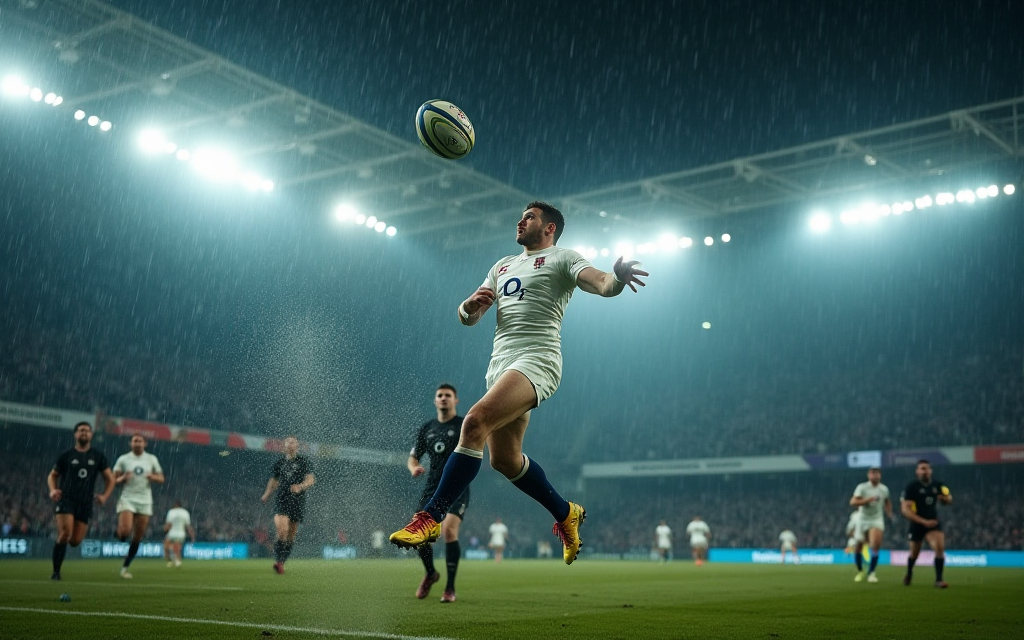
New Zealand Expose England’s Tactical Rigidity in 26-8 Twickenham Rout
England's tactical inflexibility was laid bare in a 26-8 defeat to New Zealand at Twickenham. Despite dominating territory, the hosts' kicking game faltered in wet conditions, while the All Blacks' adaptability and clinical finishing proved decisive. The loss raises questions about England's ability to win in different ways and the suitability of their personnel for a wet-weather plan. With the Rugby World Cup on the horizon, coach Steve Borthwick must find solutions to ensure his team can adapt when conditions demand.
All Blacks Punish One-Dimensional England in Rain-Soaked Test
TWICKENHAM, England — England’s inability to adapt their attacking strategy in adverse conditions proved costly as New Zealand secured a dominant 26-8 victory at Allianz Stadium on Saturday. In a torrential downpour, the hosts persisted with a kicking game that failed to fire, while the All Blacks showcased tactical flexibility to claim a deserved win.
England had entered the match with a formidable attacking record, scoring 44 tries in six previous Nations Championship games. However, against a savvy New Zealand side, they managed just one try—a late consolation from Jamie George—despite entering the opposition 22 on 13 occasions. The defeat raises questions about England’s ability to switch tactics mid-game and the suitability of their personnel for a wet-weather plan.
Kicking Game Backfires as All Blacks Capitalize on Errors
Both teams relied heavily on the boot, with New Zealand kicking 35 times to England’s 31. But the visitors’ kicks were more accurate and strategically astute, consistently turning defense into attack. England’s kicking, particularly from fly-halves Fin Smith and Marcus Smith, was often wayward, handing New Zealand counter-attacking opportunities.
The first try epitomized England’s struggles. From a Jack van Poortvliet box-kick, England failed to recover possession, and New Zealand swiftly moved the ball through Rieko Ioane and Cortez Ratima before Wallace Sititi powered over from close range. The second try, a blindside dart from Cam Roigard, further highlighted New Zealand’s ability to exploit unstructured play.
“The kick strategy always gets looked at when it is executed poorly,” said England head coach Steve Borthwick afterward. But the question remains: was the strategy flawed, or was the execution simply not good enough? With George Ford and Owen Farrell—both renowned for their tactical kicking—absent, England lacked the precision to make the plan work.
Personnel Puzzle: Missing Pieces in England’s Tactical Jigsaw
England’s current squad is built around a running, passing game, as evidenced by their free-flowing performances earlier in the autumn. But when conditions demanded a more conservative, kick-heavy approach, the players on the field seemed ill-equipped to deliver. Marcus Smith, introduced off the bench, struggled to adapt, his usually reliable boot betraying him.
The absence of Ford, Joe Marchant, and Noah Caluori—players whose skill sets might have suited Saturday’s conditions—was keenly felt. Ford, in particular, orchestrated England’s victory over New Zealand a year ago with a masterclass in game management. His absence left a void that neither Smith could fill.
“We’re not the finished article,” admitted captain Maro Itoje. “We always knew that and we knew that last week.” Indeed, New Zealand’s victory was a stark reminder of the gap between potential and performance at the highest level.
Looking Ahead: Borthwick’s Challenge to Build a Multi-Dimensional England
England’s autumn campaign, which included three impressive victories, was still a step forward. But this defeat exposed a fundamental issue: the team’s inability to win in different ways. As Borthwick looks ahead to the Rugby World Cup, he must develop a squad capable of executing multiple game plans, not just the one that suits their natural instincts.
The All Blacks, meanwhile, demonstrated why they remain the benchmark for tactical adaptability. Their ability to shift gears, to kick with purpose, and to seize crucial moments proved decisive. For England, the lesson is clear: in top-level rugby, flexibility is not optional—it is essential.
“We couldn’t get our attack going,” Borthwick conceded. The challenge now is to ensure that when the rain falls again, England have the tools and the nous to weather the storm.