

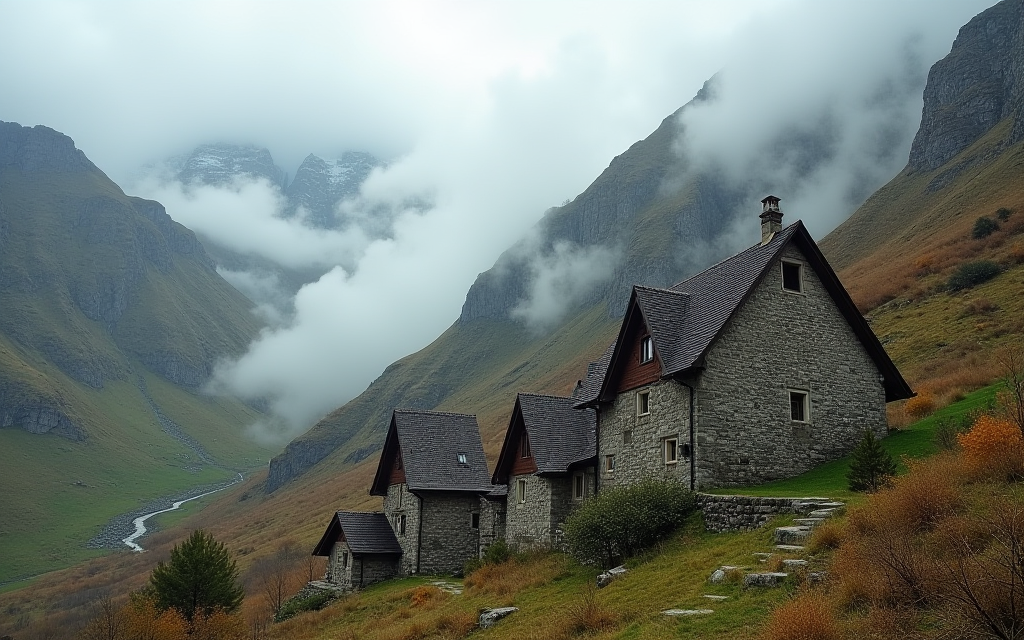
Lukomir: Inside One of Bosnia’s Last Semi-Nomadic Villages
High in the Balkans, Lukomir is Bosnia and Herzegovina's last semi-nomadic village, where shepherds still practice centuries-old traditions. Visitors can stay in stone katuns, learn to make pita, spin wool, and experience a way of life that has survived for over 500 years.
High in the Balkans, the village of Lukomir clings to a mountain ridge above the Rakitnica Canyon, offering a rare glimpse into a way of life that has endured for centuries. As Bosnia and Herzegovina’s highest and most isolated mountain village, Lukomir is considered the last semi-nomadic settlement in the country—a living ethnological museum where shepherds still guide their flocks to lower altitudes each winter and return in the spring.
A Journey Back in Time
The trek to Lukomir begins in the village of Umoljani on Bjelašnica Mountain, the trailhead for a 7km hike that winds past the dramatic rock formation known locally as “the dragon.” According to legend, a dragon emerged from Rakitnica Canyon and carved the S-shaped river Studeni potok with its tail before freezing into the rock above Umoljani.
As hikers ascend, heavy mist hovers over the peaks and sweeping vistas reveal burnt autumnal hues. The route passes 14th-century stećci—medieval tombstones—before entering Lukomir through a dramatic V-shaped crevice between boulders. The village itself is a cluster of steep-roofed stone homes, many of which were renovated with patchwork tin or metal roofs after the Bosnian War ended in 1995, yet still bear the name katun—the traditional two-room stone-and-wood structures with steeply pitched roofs.
Centuries-Old Traditions
Lukomir has been home to herders and farmers for more than 500 years. Muslim shepherds are at the heart of this lifestyle: for centuries, villagers led flocks from Gornji Lukomir (Upper Lukomir) to the now-abandoned Donji Lukomir (Lower Lukomir). Today, locals still cultivate wool and leave for winter residences in late October or early November, mostly to Hadžići, a suburb of Sarajevo. Those who still own sheep guide them on a 10-hour walk from Lukomir to their winter homes, and the sale of sheep and wool products provides income for villagers.
Some residents, like Rahima and Vejsil Čomor, a couple in their 80s, continue to live in the remaining rustic katuns—outfitted with just a wood-burning stove and an adjacent bathroom. Vejsil carves spoons from white maple, while Rahima sells traditional handmade wool socks. They remember the old days when Lukomir was full of inhabitants and villagers regularly participated in ganga—an ancient form of rural polyphonic folk singing—and kolo (circle) dancing. Today, these traditions are only performed at teferič, a traditional outdoor gathering held on the first Sunday in August.
Experiencing Village Life
Visitors can immerse themselves in Lukomir’s ancient arts through homestays like that of Saima and Omer Čomor. Saima welcomes guests into her kitchen to learn the art of making pita, a savoury cheese-filled spiral pastry that has nourished people in the Balkans for centuries. Together, she and her guests stretch dough paper-thin, add a filling of eggs and fresh young cow’s cheese, and roll it into a long, thin snake before coiling it into a round pan and baking it in a wood-burning oven.
But pita is just one of the village’s traditions. Saima also teaches visitors how to spin wool yarn on a manual spinning wheel and crochet. She dresses guests in traditional Lukomir folk costumes—long tunics with hand-stitched geometric embroidery, headscarves, and thick hand-knitted wool socks. Overnight stays at Saima and Omer’s house cost €30, and pita-making lessons cost €15. Guesthouse Ljetnja Basta Lukomir offers car parking and serves delicious traditional food in its restaurant.
A Changing Community
Lukomir’s population has dwindled since the end of the Bosnian War. According to Saima, there are now 55 people and 25 families, most living two to a house. The descendants of the Masleša and Čomor families still comprise the majority of the population. The village Imam recalls that before the war, “We lived like one family, went from house to house. In 1995 there were 14 weddings, then the girls married and left the village. Now, everyone watches their phone.”
Despite the challenges, tourism has brought new life. Lukomir now receives approximately 100,000–150,000 tourists per year who want to witness the ancient lifestyle, and hikers stop over along the Via Dinarica, a trail running through the Dinaric Alps from Slovenia to North Macedonia. Saima has hosted guests from America, Australia, and Europe. “God gave us mercy because tourists come,” she says. “After that tough life, now the whole world comes here.”
For those who make the journey, Lukomir offers more than stunning landscapes—it offers a connection to a vanishing way of life. As Saima told her guest upon departure, “Now, you are not a stranger to me. I will remember you.”
