

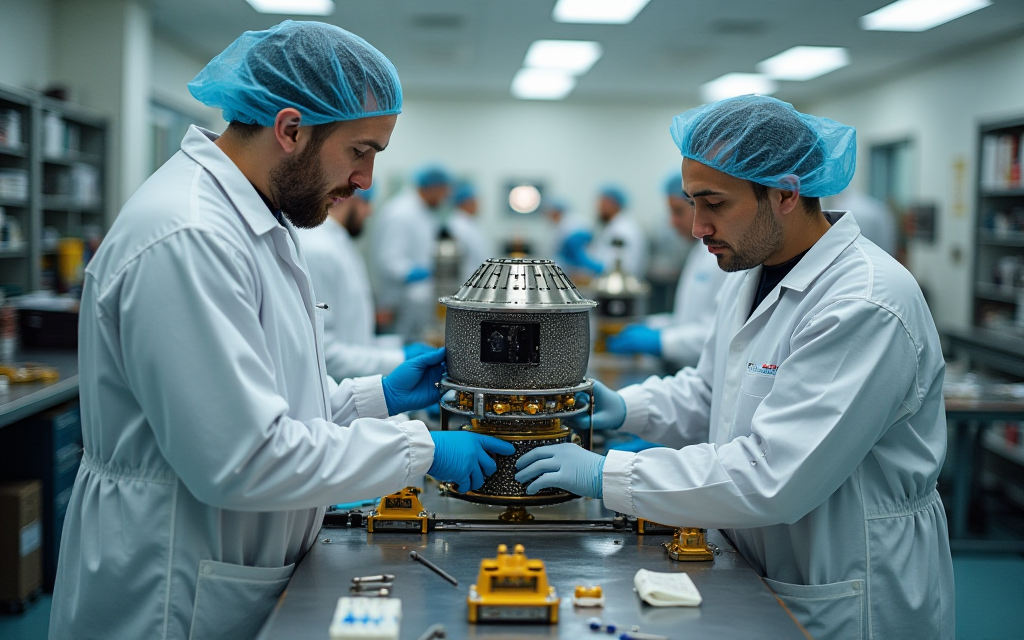
NASA’s Dragonfly Rotorcraft Equipped with Cameras to Explore Titan
NASA's Dragonfly rotorcraft, set to explore Saturn's moon Titan, has received its advanced camera system. The DragonCam suite will provide high-resolution imaging and navigation capabilities, enabling the rotorcraft to safely land and study Titan's surface chemistry and potential habitability. Scheduled to launch in 2028, Dragonfly will be the first spacecraft to fly its science payload to multiple locations on another world.
NASA’s Dragonfly Mission Takes Shape with Advanced Imaging Suite
NASA’s Dragonfly rotorcraft, destined for Saturn’s moon Titan, has received its ‘eyes’—a sophisticated suite of cameras that will capture the alien world’s landscapes and help scientists navigate the drone-like vehicle through Titan’s thick atmosphere. The Dragonfly mission, part of NASA’s New Frontiers program, is scheduled to launch in 2028 and arrive at Titan in 2034.
The camera system, known as DragonCam, includes a high-resolution color camera and a set of navigation cameras that will provide stereo vision for safe landing and hazard avoidance. These instruments are crucial for the rotorcraft to identify safe landing spots and study the moon’s chemistry and potential habitability.
DragonCam: A Window into Titan’s Mysteries
The DragonCam suite consists of six cameras: two forward-looking cameras for navigation, two downward-looking cameras for landing, and two science cameras. The science cameras will capture panoramic images of Titan’s surface, which is obscured by a thick nitrogen atmosphere and organic haze. They will also help identify areas of interest for further exploration.
“The DragonCam system is the most complex camera suite ever sent to a planetary body,” said Sarah Horst, a planetary scientist at Johns Hopkins Applied Physics Laboratory and a member of the Dragonfly science team. “It will allow us to see Titan’s surface in unprecedented detail and help us understand the processes that shape this unique world.”
The cameras are designed to operate in Titan’s extreme environment, where temperatures hover around -290 degrees Fahrenheit (-179 degrees Celsius) and the atmosphere is 1.5 times denser than Earth’s. The cameras will be housed in a protective casing to shield them from the cold and radiation.
Navigating Titan’s Skies
The navigation cameras are essential for Dragonfly’s flight. Titan’s dense atmosphere and low gravity make it an ideal place for rotorcraft flight, but the moon’s distance from Earth means the spacecraft must operate autonomously. The navigation cameras will provide real-time images to the onboard computer, which will use them to avoid obstacles and select safe landing sites.
“Flying on Titan is like flying on Earth but with a much thicker atmosphere,” said Doug Adams, Dragonfly project manager at APL. “The navigation cameras will give Dragonfly the situational awareness it needs to fly safely and carry out its science mission.”
The navigation cameras are based on the design used for the Mars Helicopter Ingenuity, which has been successfully flying on Mars since 2021. However, the Titan cameras are adapted to operate in a different environment, with larger lenses and more sensitive sensors to compensate for the low light levels under Titan’s hazy skies.
Science Goals and Future Exploration
Dragonfly’s primary science goal is to study Titan’s prebiotic chemistry and search for signs of life. Titan is thought to have a subsurface ocean of liquid water, and its surface is rich in organic molecules. The rotorcraft will land at multiple sites and use its instruments to analyze the surface composition and atmospheric conditions.
The camera system will play a key role in this endeavor by providing context for the other instruments and capturing images of the moon’s diverse landscapes, including dunes, lakes, and river valleys. The images will also be used to create maps and 3D models of the landing sites.
“The DragonCam images will be a treasure trove for scientists,” said Elizabeth Turtle, Dragonfly principal investigator at APL. “They will help us understand the geology and chemistry of Titan and pave the way for future exploration.”
With its cameras now integrated, Dragonfly is one step closer to launch. The mission team is currently testing the rotorcraft’s systems and preparing for the next phase of development. If all goes as planned, Dragonfly will be the first spacecraft to fly its entire science payload to multiple locations on another world, opening a new era of planetary exploration.
