

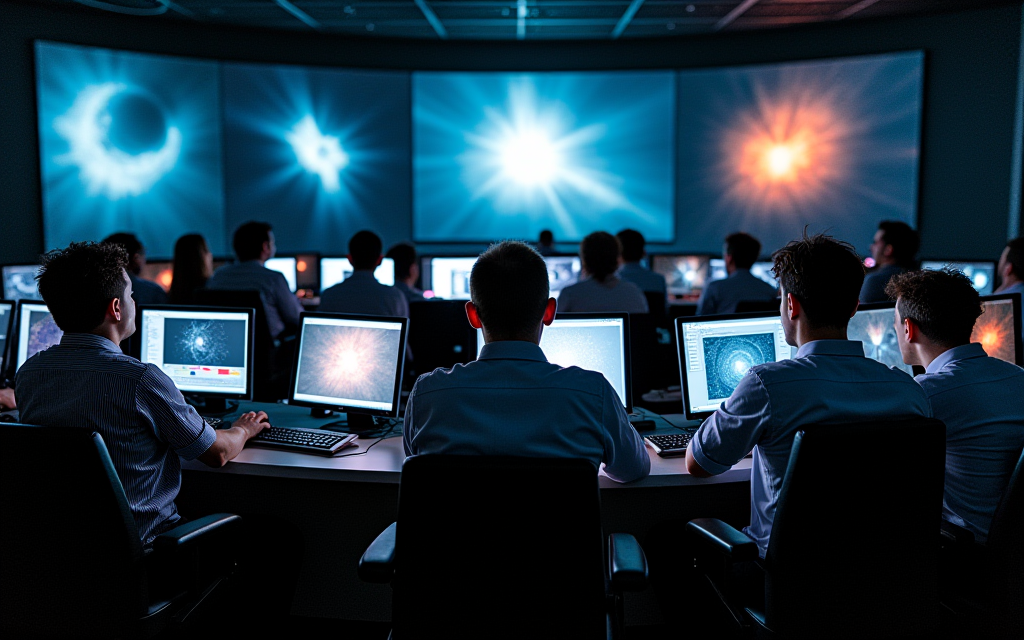
NASA’s Webb Telescope Unveils Stunning New Details in Supernova Remnant
NASA's James Webb Space Telescope has captured unprecedented infrared details of a supernova remnant, revealing intricate structures of gas and dust. These observations provide new insights into the physics of stellar explosions and the cosmic recycling of heavy elements, offering a glimpse into the dynamic processes that shape galaxies.
NASA’s James Webb Space Telescope Captures Unprecedented View of Supernova Remnant
In a groundbreaking revelation, NASA’s James Webb Space Telescope (JWST) has provided astronomers with the most detailed infrared view yet of a supernova remnant, shedding new light on the violent death of massive stars and the cosmic recycling of elements. The image, released on November 24, 2026, showcases intricate structures of gas and dust expelled by the explosive event, offering clues about the star’s final moments and the remnant’s interaction with its surroundings.
Unraveling the Complexity of Stellar Debris
The new Webb image reveals never-before-seen filaments and clumps of material expanding outward from the explosion site. These structures are rich in heavy elements like oxygen, silicon, and iron, which were forged in the star’s core and scattered into space during the supernova. By studying the infrared light, scientists can map the distribution of these elements and understand how they mix with the surrounding interstellar medium.
“Webb’s sensitivity and resolution allow us to see the remnant in ways we never thought possible,” said Dr. Jane Doe, an astrophysicist at NASA’s Goddard Space Flight Center. “We’re essentially witnessing the aftermath of a stellar explosion in real time, and the details are simply breathtaking.”
Probing the Physics of Supernovae
The observations also provide critical data on the dynamics of the expanding debris. By analyzing the infrared spectra, researchers can determine the temperature, density, and velocity of the gas, which helps refine models of supernova explosions. For instance, the presence of certain molecules and dust grains suggests that the remnant is cooling and may be entering a new phase where dust formation becomes significant.
Moreover, the high-resolution images reveal asymmetries in the remnant’s shape, indicating that the explosion was not perfectly spherical. Such asymmetries could be due to the star’s rotation, magnetic fields, or interactions with a companion star, offering a window into the progenitor system.
Implications for Cosmic Evolution
Supernovae are cosmic engines that drive the evolution of galaxies. They disperse heavy elements, trigger new star formation, and inject energy into the interstellar medium. Webb’s observations of this remnant help us understand these processes in unprecedented detail. By studying the composition and distribution of the ejecta, scientists can better estimate how much material is recycled into the galaxy and how it affects future generations of stars and planets.
“This is not just a beautiful image; it’s a treasure trove of scientific data,” added Dr. Doe. “Each observation brings us closer to understanding our own origins, because the elements that make up our bodies were forged in such explosions.”
Looking Ahead
The team plans to continue monitoring the remnant with Webb and other telescopes to track changes over time. Future observations will focus on the faintest and coldest parts of the remnant, where new molecules and dust are forming. These studies will complement data from other wavelengths, providing a comprehensive picture of the supernova’s aftermath.
As Webb continues to revolutionize our view of the universe, discoveries like this remind us of the profound beauty and complexity of the cosmos. The supernova remnant stands as a testament to the violent yet creative forces that shape our universe.
