

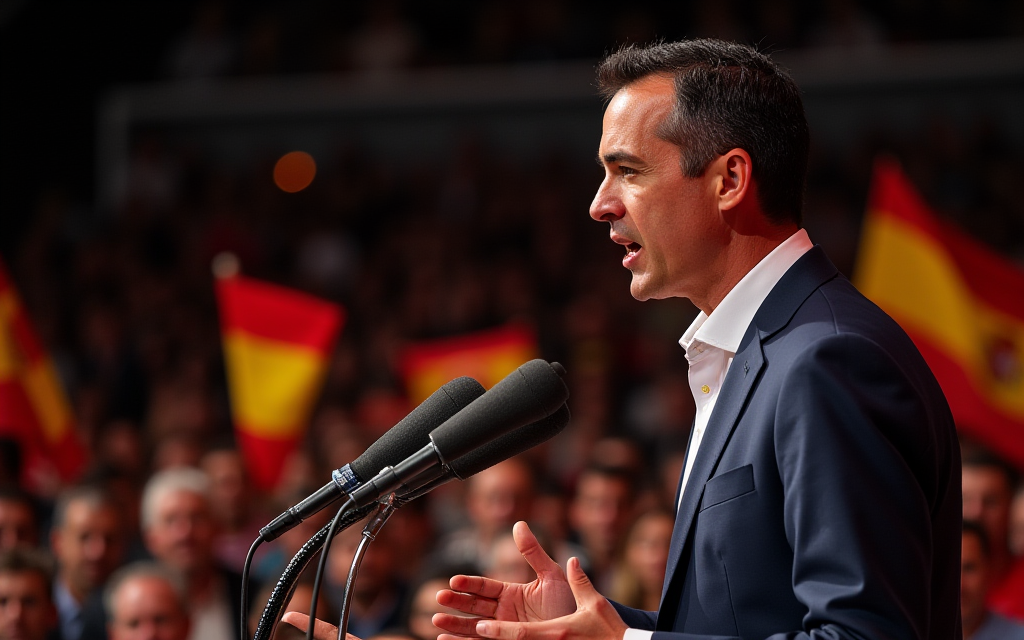
Spain’s Election: Sánchez Warns of Far-Right Threat as PP and Vox Surge
Spain's general election sees a deeply polarized nation choosing between Socialist Prime Minister Pedro Sánchez, who warns against the far-right, and the conservative PP, likely to coalition with Vox. Sánchez's reliance on separatist parties and corruption scandals have fueled right-wing criticism, while the left fears social regression under a PP-Vox government. The election is a battle of ideologies, with both sides claiming the other threatens democracy.
Spain’s Election: Sánchez Warns of Far-Right Threat as PP and Vox Surge
As Spain heads to the polls on Sunday, the country is deeply divided between two opposing political visions. Prime Minister Pedro Sánchez, a Socialist, has warned voters against the rise of right-wing governments globally, while the conservative People’s Party (PP) and the hard-right Vox party appear poised to take power.
Sánchez’s Warning from the Wrestling Ring
Speaking in a wrestling ring on the island of Tenerife, Sánchez cautioned supporters about the spread of right-wing governments, citing examples such as Donald Trump in the US, Jair Bolsonaro in Brazil, and Javier Milei in Argentina. “What good has President Trump done the United States and, by extension, the world – was he a change or a step backwards?” he asked. “If we don’t want that for the world, why would we want it for our own country?”
Sánchez has gained a reputation as Europe’s most outspoken left-wing prime minister, defending feminism, immigration, and green energy, and condemning Israel’s military action in Gaza. His strident rhetoric has made him a hero to the international left but a hate figure for the Spanish right.
PP and Vox: A Coalition of the Right?
Meanwhile, PP leader Alberto Núñez Feijóo, speaking in a bullring in Valencia, told supporters that the last few years of Socialist-led government had been “insulting and even humiliating for a lot of people.” He added: “We know them, they are capable of anything.”
Ignacio Garriga, spokesman for Vox, went further, describing Sánchez as “a very dangerous psychopath.” Both parties have cast doubt on the neutrality of postal votes and votes from abroad, suggesting government manipulation.
Political scientist Cristina Monge of Complutense University notes: “This is a campaign that is overwhelmingly ideological. That means that it is not so much about voters rewarding or punishing a government’s performance or the proposals being made, but about belonging to one or other ideological bloc.”
Corruption Scandals and Judicial Investigations
Much of the hostility to Sánchez stems from his reliance on hard-left and separatist parties. Ahead of the 2023 election, he faced criticism for relying on EH Bildu, linked to the defunct Basque armed group ETA. After the vote, he formed a government with the support of Together for Catalonia (Junts) in exchange for amnesty for Catalans involved in the failed 2017 independence bid.
Núñez Feijóo accused Sánchez of being “a prime minister who has bought his investiture in exchange for the judicial impunity of his partners.” Political scientist Guillermo Fernández Vázquez of Carlos III University said these partnerships “fed the rhetoric of the right and far right, which was that Pedro Sánchez is an amoral person without scruples – someone whose word can’t be trusted and who just wants to remain in power.”
The prime minister has also been dogged by judicial investigations involving close associates and family members. He has acknowledged errors in trusting former Socialist Party associates José Luis Ábalos, sentenced to 24 years for corruption, and Santos Cerdán, awaiting trial on similar charges. However, he has defended his former attorney general, Álvaro García Ortiz, and his brother David, both barred from office, and his wife Begoña Gómez, due to stand trial for influence peddling. Sánchez claims these cases are “nasty politics, not corruption,” blaming political opponents for using the judiciary to destabilise his government.
Vox leader Santiago Abascal describes the government as “a criminal mafia.” María Pérez, a young office worker with no political allegiance, plans to vote for the PP partly due to the judicial investigations: “I think that Sánchez has lost credibility with all the corruption cases. It seems that everyone in government is involved… so I’m not sure I want them to continue governing. I believe it’s time for a change.”
Regional Alliances and Social Regression Fears
With the far right seemingly set to enter government for the first time in Spain’s democratic era, claims of demagoguery cut both ways. Left-wing politicians point to PP-Vox coalitions in four of Spain’s 17 regions as a blueprint for socially regressive policies. In all four, Vox has negotiated “national priority,” giving Spaniards priority access to public services and subsidies over foreigners.
In Castilla y León, a play about left-wing poet Federico García Lorca was cancelled, apparently at the behest of the Vox-controlled local culture ministry. Last month, the same department published guidelines stating that projects involving “ideological indoctrination” would not be eligible for film subsidies. Spain’s culture minister, Ernest Urtasun, called this “an intolerable attempt at censorship.”
Susana Fuertes, a schoolteacher voting for the left, said such moves are a sinister throwback to the Franco era: “These political messages take us back to the Franco era by talking about getting rid of basic civil rights regarding women, gender equality and immigration. All of this has been said in such an aggressive tone, with insults and lack of respect for people who don’t share the same ideas.”
As Spain votes, the choice is clear: continue with Sánchez’s left-wing vision or embrace a right-wing coalition that promises change but raises fears of social regression. The outcome will shape not only Spain’s future but also the political landscape of Europe.
