

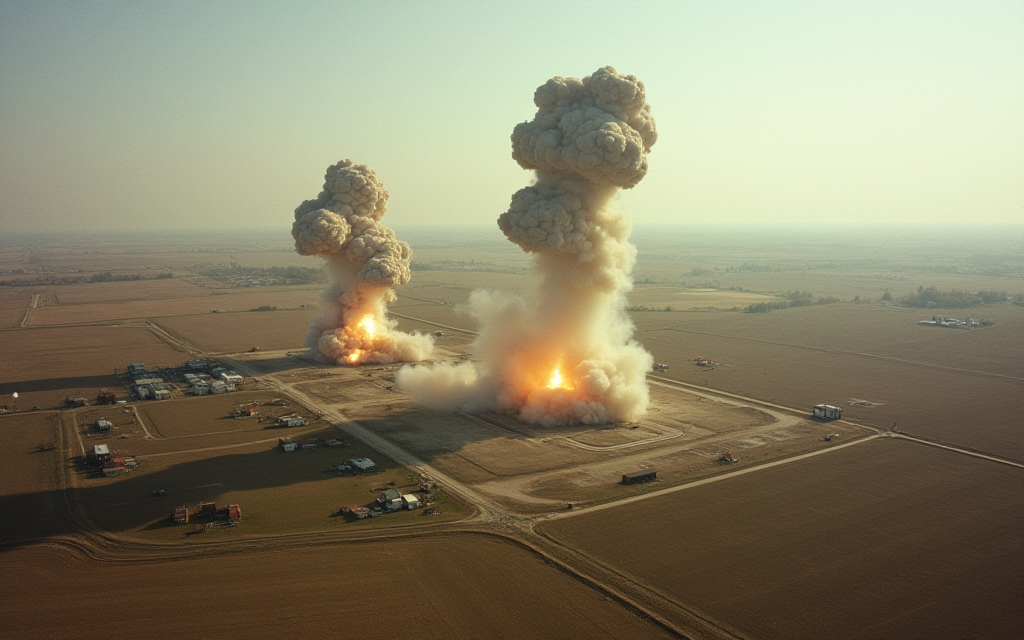
US Army Detonates 10,000 lbs of Toxic Lead Explosives in Iowa Amid Health and Environmental Backlash
The US Army detonated nearly 4,500kg of lead azide at the Iowa Army Ammunition Plant on Wednesday, ending a legal battle but raising fears of toxic fallout. Environmental groups warn lead particles could travel over 100 miles, contaminating homes, crops, and livestock. Residents in already strained communities question the added burden, while farmers brace for potential soil and water contamination. The Army defends the controlled detonation as safer than an uncontrolled blast, but health officials in Missouri advise sheltering in place.
Controlled Detonations End Legal Battle but Raise Fears of Toxic Fallout
The US Army carried out two successive open-air detonations on Wednesday morning to destroy nearly 4,500kg (10,000lb) of lead azide, a highly volatile explosive used in military munitions since World War I, at the Iowa Army Ammunition Plant. The blasts, which occurred around 9am local time (15:00 GMT), ended a brief legal battle but ignited concerns among residents, environmental groups, and public health experts about the release of toxic lead particles that could travel more than 160km (100 miles).
Before the detonations, outgoing Republican Governor Kim Reynolds declared a disaster emergency across Des Moines, Lee, and Van Buren counties, activating state and county emergency response plans. Revised wind projections released by the Army on Tuesday indicated that airborne lead particles would shift southwest into northeast Missouri, prompting health officials there to advise residents 8km to 32km (5 to 20 miles) southwest of the plant to shelter indoors with windows and doors shut until an all-clear is issued.
Assistant Secretary of the Army Jordan Gillis defended the decision in a video on X, stating, “The choice that we faced here was between a spontaneous, uncontrolled detonation of dangerous material or a controlled detonation where we could choose the time and place to optimize the conditions to deliver the best result – not just for our operation but for the safety of the public.”
Communities Already Under Strain Brace for Added Burden
The detonation’s impact will be felt acutely in Des Moines County, home to about 38,000 Iowans, where 38 percent of households fell below the Asset Limited, Income Constrained, Employed (ALICE) threshold in 2024, according to United for ALICE. The county includes Burlington and the rural community of Middletown, immediately adjacent to the ammunition plant.
Megan Brincks, chairwoman of the Burlington Homelessness Task Force and a former chemistry lab worker at the plant, told Al Jazeera, “We shouldn’t have to experience an environmental disaster to become worthy of national attention or investment.” She emphasized that shelter-in-place orders cannot suspend daily obligations: “Our food-insecure families will still need food tomorrow. People experiencing homelessness will still need shelter. Individuals will still need transportation to medical appointments. Unfortunately, the world doesn’t stop spinning because this is happening in our back yard.”
Environmental groups have warned that lead particles could land on homes, crops, and livestock far beyond the detonation site, exacerbating existing economic pressures, including a shortage of affordable housing, rising food costs, and stretched local services.
Agricultural Heartland Faces Risk of Lead Contamination
The blasts rocked one of southeastern Iowa’s most heavily cultivated stretches, in a state that ranks second only to California in agricultural output value. According to the US Department of Agriculture (USDA), Iowa is a leading producer of corn and soya beans and ranks first in the country in commercial red meat and egg production. Across Des Moines County, about 648 farms span nearly 60,300 hectares (149,000 acres), including more than 49,775 hectares (123,000 acres) of cropland.
On Tuesday, Richard Fordyce, an undersecretary at the USDA, said the agency and the Iowa Department of Agriculture and Land Stewardship estimated that about 350 farms across Iowa and Missouri could lie within the projected plume area. The prospect has stoked alarm over the risk of lead leaching into soil and groundwater, compromising crops and livestock and jeopardizing the livelihoods of farmers whose land underpins a vital part of the country’s food supply.
Will Sander, an associate professor of preventive medicine and public health at the University of Illinois Urbana-Champaign, noted that much of Iowa’s corn and soya bean harvest has already been completed, reducing the likelihood of acute exposure to this season’s crops. However, he advised cattle producers to cover feed and water supplies where possible to limit animals’ ingestion of lead dust. “The acute exposure is the biggest risk in this situation… that lead will not have dispersed and diluted into the environment,” Sander told Al Jazeera.
Eri Saikawa, a professor of environmental sciences at Emory University, added, “For these farmers, land is their currency. It is not acceptable that their livelihood is impacted this way. It also impacts all of us who rely on these farmers and their crops.”
