

Inside London Museum’s New Smithfield Home: Fatbergs, Feathers, and Flocks of Sheep
The London Museum opens in the restored Smithfield Market after a £437m transformation. Inside, visitors find a life-size giraffe, plastic sheep, a chunk of fatberg, and thousands of artifacts spanning Roman London to the 2012 Olympics. Director Sharon Ament calls it a shared space for everyone, reflecting the city's 'grit and glitter.'
After a decade of planning and a £437 million investment, the London Museum has transformed the abandoned halls of Smithfield Market into a sprawling new cultural venue. Opening to the public on Saturday, the museum blends Victorian architecture with cutting-edge exhibits, offering a journey through London’s gritty and glittering history.
A Grand Entrance: Real Time and Our Time
Visitors begin their experience in Real Time, a covered street where digital displays pulse with live data about London. A Banksy-graffitied sentry box and the last bell cast at the Whitechapel Bell Foundry hint at the city’s layered past. Moving into the former General Market, now called Our Time, the space bursts with living memory: a life-size mechanical giraffe, remnants of greyhound tracks, and even the old switchboard from Buckingham Palace.
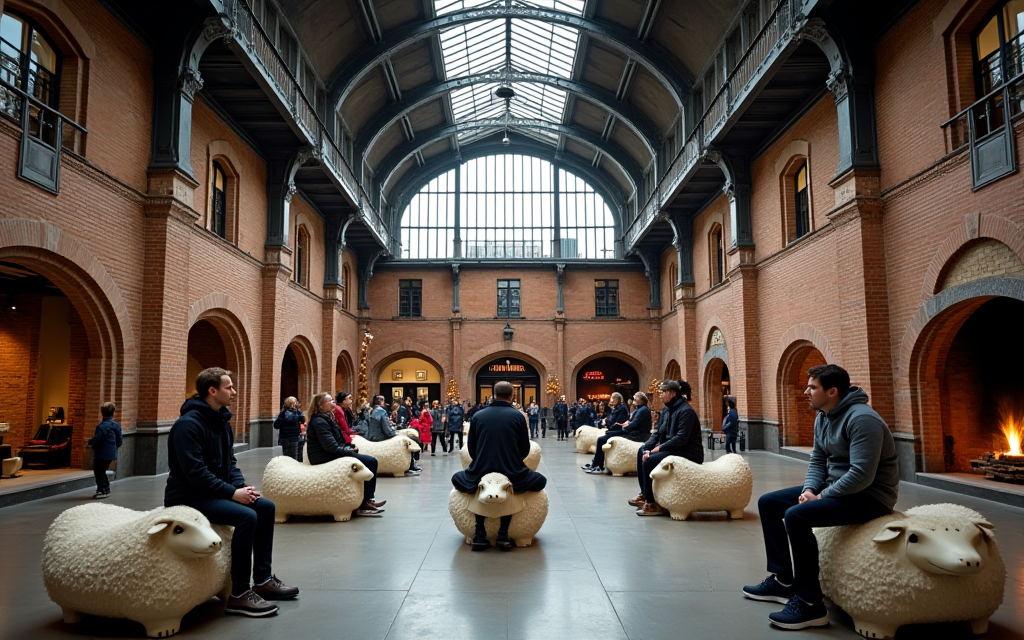
Under the magnificent domed ceiling, flocks of large plastic sheep invite visitors to sit and reflect. Museum director Sharon Ament says, “There are grins on people’s faces, so I think we’ve pulled something rather incredible off.” The area will also host late-night events, shops, and eateries, including 24-hour Victorian cocoa rooms on weekends.
Descending into History: Past Time
A wide staircase leads down to Past Time, located at what was once the street level of Roman London. Here, beneath a seven-metre-high brick vaulted ceiling, a weaving route tells London’s story from its Roman creation through medieval times, the British Empire, and up to the 2012 Olympics. Curator Annette Day explains, “We felt that right in the guts, in the earth of the city, that was the place where we should explore London.”
Among the treasures are Charles I’s execution vest, Queen Victoria’s mourning dress, a white 1960s Ford Cortina, and the shimmering Elizabethan jewellery of the Cheapside Hoard. A taxidermy cat named Oliver and a chunk of the infamous Whitechapel fatberg add a touch of the macabre. Large comic illustrations bring the Great Fire of London to life, while galleries showcase 2,000 years of London-made shoes and a collection of toilets and chamber pots.
Preserving the Past, Building for the Future
The restoration project, led by Alec Shaw, has carefully preserved historic fabric, including the traders’ fireplaces and twisting metal staircases. “We wanted a museum that worked like the market, that allowed you to come in any corner and just walk across,” Shaw says. The museum currently displays 5,000 objects from its seven-million-piece collection, with 300,000 more set to arrive when the former Poultry Market opens in 2028.
Ament envisions the museum as a shared space for everyone, comparing it to her favourite bus route: “You meet the world on it. And you meet the world in here.” With its tagline “grit and glitter,” the London Museum embraces the dualities of the city’s history. As Ament puts it, “We are making a museum and it will never stop, just like London never stops.”
