

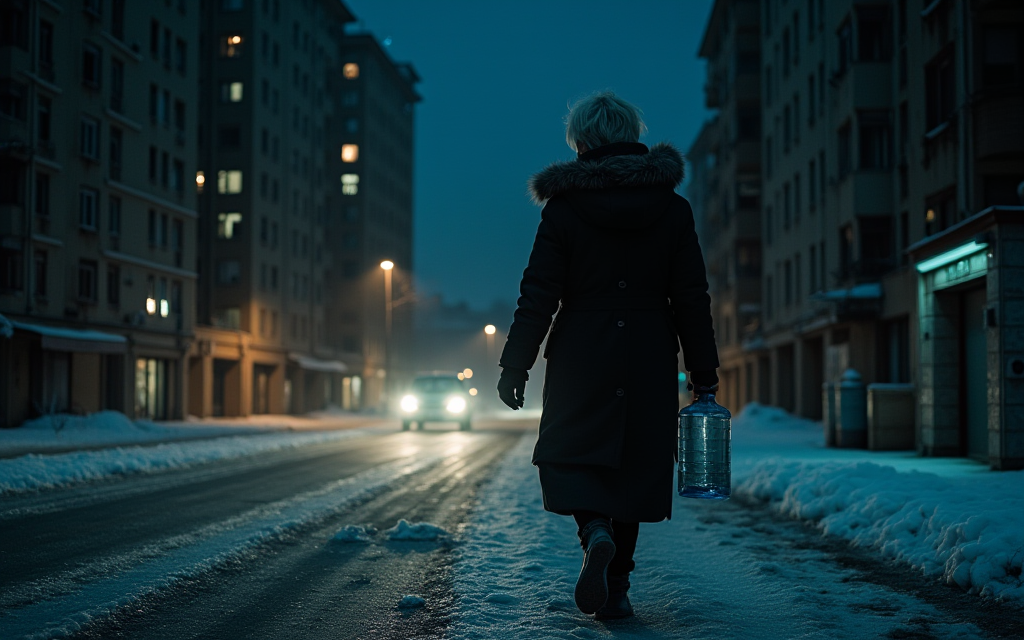
Ukraine Enters Another Winter of War: Blackouts, Missile Strikes, and Unbroken Resolve
As Ukraine enters its fourth winter of war, missile strikes on energy infrastructure leave cities dark and cold, but Ukrainians remain defiant. Polls show 62% are willing to endure the war indefinitely, and 79% believe in victory. Despite blackouts, cultural resilience thrives, and calls for surrender fall on deaf ears. With peace talks stalled and distrust of Russia deep, Ukraine braces for another season of hardship with unbroken resolve.
Ukraine Braces for Another Winter Under Russian Bombardment
KYIV, Ukraine — As temperatures drop below freezing, Ukraine is facing its fourth winter since Russia’s full-scale invasion, with relentless missile and drone strikes targeting energy infrastructure and leaving millions without heat, water, or electricity. Despite the hardships, interviews and recent polling suggest that Ukrainians remain defiant, unwilling to surrender or accept a peace deal on unfavorable terms.
The war, now in its fourth year, has killed an estimated 100,000 Ukrainian troops and 18,000 civilians, according to the United Nations, though the true toll is likely higher. Infrastructure across the country has been battered, and nightly blackouts have become a way of life. Yet the mood in Kyiv is one of weariness mixed with fury, not capitulation.
Missile Strikes and the Battle of the Bridges
In mid-November, the conflict escalated with a series of strikes on key bridges. Ukraine attacked the Kerch Bridge linking Russia to occupied Crimea, and Russia retaliated by firing seven ballistic missiles at Kyiv, disabling two of the nine bridges across the Dnipro River. The attacks have made daily life increasingly difficult, but they have also hardened resolve.
During one of the heaviest attacks last week, air raid sirens wailed across the city, and explosions lit up the night sky. “I jumped out of bed and stared out of the window into the darkness,” reported a journalist in Kyiv. “After a few seconds two more missiles landed, lighting up the entire sky momentarily in a blaze of white and red. They were uncomfortably close.”
Many residents seek shelter during alerts, while others choose to stay in bed, hoping the law of averages will protect them. The attacks come by day and night, making normal life almost impossible. “An uninterrupted night’s sleep is a rarity,” the journalist noted.
Public Opinion: Willing to Endure
A poll conducted last month by the Kyiv International Institute of Sociology (KIIS) found that 62% of Ukrainians are prepared to endure the war for as long as it takes. Seventy-nine percent believe Ukraine will ultimately win, while only 7% think Russia will emerge victorious. These figures underscore a nation that, despite exhaustion, remains committed to its fight for sovereignty.
Trust in President Volodymyr Zelensky hovers around 54% to 57%, down from 90% in the early days of the war but still relatively high after more than seven years in power. While some, like an elderly woman holding a photo of her missing son in Independence Square, blame Zelensky for the continued suffering, most seem to support his leadership.
Cultural Resilience and National Identity
Beyond the battlefield, Ukrainians are reaffirming their national identity. The war has sparked a revival of Ukrainian culture, from language to cuisine. On the set of MasterChef Ukraine, executive producer Oleksandr notes that “people see our cuisine as a way of expressing their national identity.” The show’s studio was borrowed after the original was bombed, and the producer keeps his phone close, ready to shepherd everyone to a shelter when air raid alerts sound.
Literature has also become a front in the cultural war. “Woe betide a writer who uses Russian spellings,” a Ukrainian novelist said, highlighting the emphasis on linguistic differences. Even borsch, the beetroot soup beloved across Eastern Europe, is proudly claimed as Ukrainian. “They call borsch theirs, but they got it from us,” a waiter in Kyiv said.
Despite the hardships, life goes on. In the afternoon, young people gather outside a nightclub for a rave, a brief respite from the war. “It’s a way of getting a bit of respite from everything,” one woman said. “It makes me feel I can put up with everything,” a man added.
The Path to Peace: Stalemate and Distrust
Diplomatic efforts to end the war have so far failed to gain traction. Rumors of a US-backed plan that would see Ukraine cede territory in the east in exchange for NATO membership were dismissed as a non-starter, as Russia would never accept such terms. Ukrainians express deep distrust of Russia and skepticism about any peace deal.
“They signed a treaty to accept our borders, and Putin broke it,” a young man said. “The only solution is to defeat them.” Others speak of the need for massive reparations, with reconstruction costs estimated at over $500 billion—an unthinkable sum for a country whose pre-war GDP was $200 billion.
For Russian President Vladimir Putin, the war is personal. Having staked his reputation on the invasion, a defeat could spell disaster for his rule. As one observer noted, Putin is said to have remarked that if he doesn’t win, “they’ll hang me.”
As winter sets in, Ukraine faces months of hardship. But the spirit of its people, forged in war, remains unbroken. The country may be bowed, but it is not beaten.