

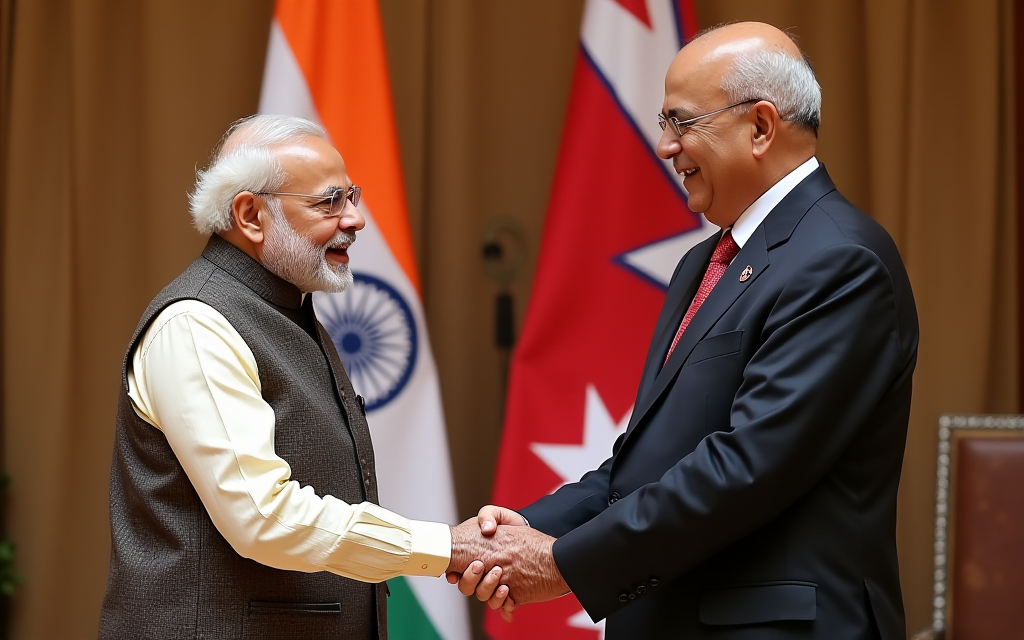
India Pledges $1.62bn to Nepal as PM Balendra Shah Seeks Reset in Ties
India has pledged a $1.62 billion economic package to Nepal during Prime Minister Balendra Shah's first official visit to New Delhi. The deal includes a line of credit for energy projects and grants for flood reconstruction, alongside agreements on trade, hydropower, and connectivity. The visit signals a reset in strained ties, though contentious issues like the border dispute were set aside. Nepal also gained access to two Indian ports and a new cross-border train service, but aviation access remains limited.
A New Chapter in India-Nepal Relations
In a significant diplomatic breakthrough, India has announced a $1.62 billion economic package for Nepal during the first official visit of Nepali Prime Minister Balendra Shah to New Delhi. The visit, which took place on November 23, 2026, marked a concerted effort by both nations to reset a relationship that has been strained by years of friction over border disputes, political interference, and trade imbalances.
The contrast between the two leaders was striking: Shah, 36, dressed in his trademark black suit and sunglasses, stood beside Indian Prime Minister Narendra Modi, 76, clad in white. Shah, a former rapper who rose to power after Gen Z-led protests toppled his predecessor, has repeatedly called for Nepal to be treated as an equal by its powerful neighbors. Modi, serving his third term, has recently faced student-led protests in India. Yet both projected warmth, exchanging gifts, inspecting a military guard of honor, and jointly flagging off a new cross-border train service.
Economic Package and Reconstruction Support
The centerpiece of the visit was India’s financial support package, which comes as Nepal recovers from devastating floods earlier this year. The floods killed more than 1,400 people, with thousands still missing, and caused widespread damage to homes, roads, and bridges. Nepal’s government estimates rebuilding costs could reach $4.8 billion. Modi pledged nearly $1.6 billion, most of it as a line of credit for energy projects, alongside about $400 million in grants for reconstruction and infrastructure.
While Nepal would have preferred a larger package, former senior Nepali diplomat Vijay Kant Karna described it as “a significant amount” that could help stabilize a relationship that has often been uneasy. The two countries also signed agreements covering trade, hydropower, transport, and education for Nepali youths.
Connectivity and Strategic Gains
Nepal, a landlocked country heavily dependent on India for trade, secured access to two additional Indian ports—Kandla and Paradip—and agreed to improve road and rail connectivity. The leaders jointly inaugurated a train service linking Ayodhya in India, revered by Hindus as the birthplace of Lord Ram, with Janakpur in Nepal, traditionally regarded as the birthplace of his wife Sita.
However, there was disappointment on aviation. Nepal has long sought greater access to Indian airspace to attract international traffic to its airports at Bhairahawa and Pokhara. Analysts believe the lack of an agreement reflects Indian concerns over Chinese involvement in the two airport projects. India did agree to make an existing air route linking Kathmandu, Bhairahawa, and Lucknow bidirectional, which former planning commission vice-chairman Govind Pokharel called “a breakthrough.”
Balancing Act: Border Dispute and China
A Hindu-majority nation wedged between India and China, Nepal has long had to navigate competing interests from its two giant neighbors. Allegations of political interference and an unresolved border dispute have frequently complicated ties with India. Notably, the border dispute was largely absent from the leaders’ public remarks, although the joint statement acknowledged that outstanding issues remained.
According to Pokharel, Shah’s government may have chosen to set contentious issues aside to secure progress on more immediate development needs. “Right now you can go home and convince the young Nepalis that it will be handled later,” Pokharel says, “but if they don’t deal with these issues in the future, there will be criticism.” Veteran Indian diplomat Anil Trigunayat says both sides appear to have opted to leave the dispute to established mechanisms rather than engage in “cartographic aggressions.”
Shah must now manage relations with China as he seeks to balance the interests of Nepal’s two much larger neighbors. For now, he returns home with substantial financial commitments from India as Nepal continues the long task of rebuilding.
