

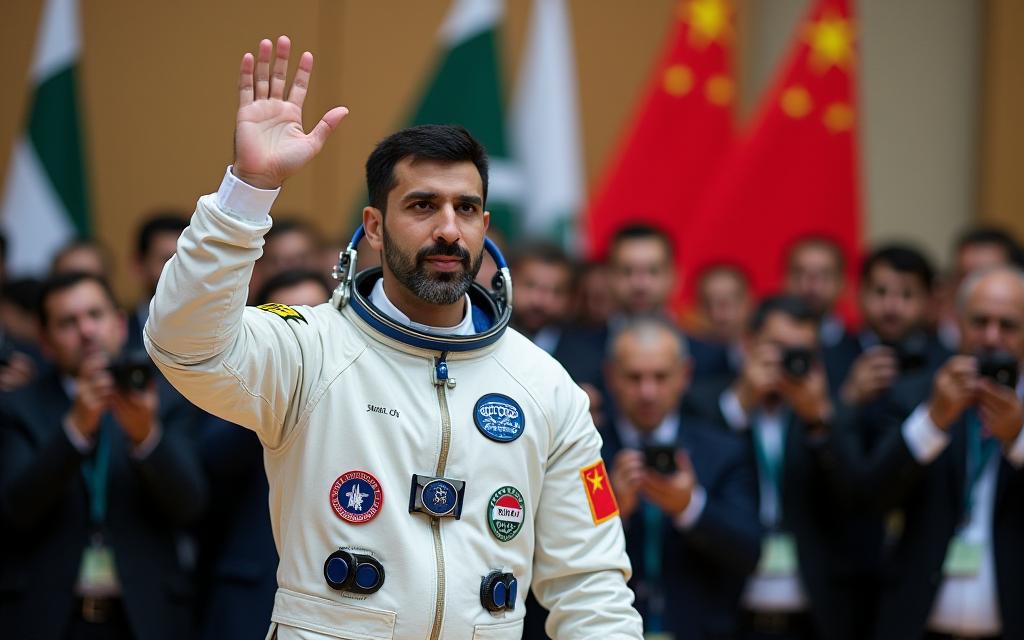
Pakistan Celebrates First Astronaut as Zeeshan Ali Docks at China’s Tiangong Station
Muhammad Zeeshan Ali becomes Pakistan's first astronaut, docking at China's Tiangong space station as the first foreign national. The historic mission highlights the strong China-Pakistan friendship and China's push for international space collaboration. Prime Minister Shehbaz Sharif calls it a journey of 240 million Pakistanis, while President Xi Jinping praises the deep-rooted ties between the nations. Ali's 5-10 day stay will include experiments and outreach, inspiring a new generation.
Historic Milestone for Pakistan’s Space Ambitions
Pakistan is celebrating a historic achievement as Muhammad Zeeshan Ali became the country’s first astronaut to enter orbit, docking at China’s Tiangong space station in the early hours of Wednesday. The 40-year-old made history as the first foreign national to board the station, marking a significant leap for Pakistan’s space program and a deepening of China-Pakistan cooperation.
Ali launched from China’s Jiuquan Satellite Launch Centre in northwest China aboard a Chinese-made rocket, accompanied by two Chinese astronauts. The mission, Shenzhou-24, underscores China’s growing role in international space collaboration and its ambition to position Tiangong as a platform for global research.
A Journey of National Pride
Ali’s journey has captured the imagination of millions across Pakistan. In a heartfelt statement to reporters before the launch, he said, “I’m not flying for myself. I carry the name of Pakistan on my shoulder.” His words resonated with a nation of 240 million people, many of whom watched the launch live on television and social media.
Pakistani Prime Minister Shehbaz Sharif hailed the mission as a national triumph. In a post on X, he wrote, “This is not just one astronaut’s journey, but the journey of 240 million Pakistanis. It is the journey of our younger generation, our scientists and our dreams.” He also praised the “ironclad friendship” between Pakistan and China, expressing gratitude for China’s role in making the mission possible.
Chinese President Xi Jinping echoed these sentiments, calling the joint mission “a vivid embodiment of the deep-rooted friendship between the two countries.” The collaboration highlights the strong diplomatic and strategic ties between the two nations.
China’s Space Diplomacy and Global Ambitions
For China, the mission represents a major diplomatic and strategic opportunity. Beijing is eager to showcase the Tiangong space station as an international research platform, open to collaboration with other countries. This move comes as China ramps up its space industry, aiming to land a Chinese astronaut on the moon by 2030 and establish a research base there by 2035 in partnership with Russia.
The United States, which plans its own lunar landing by 2028, has warned that China could seek to dominate resource-rich areas of the moon. Both Beijing and Washington insist their space activities are peaceful, but the competition for lunar resources is intensifying. Ali’s mission serves as a symbol of China’s willingness to share its space capabilities with allies, potentially reshaping global space diplomacy.
Ali’s stay aboard Tiangong will last five to 10 days, shorter than the usual six-month stints served by Chinese astronauts. During his time in orbit, he is expected to conduct experiments and engage in educational outreach, further inspiring Pakistan’s youth and solidifying the bond between the two nations.
Training and Preparation
Ali underwent months of intensive training in China, including learning Chinese, to prepare for the mission. His dedication and hard work have been praised by both Pakistani and Chinese officials, who see him as a bridge between the two countries’ scientific communities.
Future Prospects
This mission could pave the way for more Pakistani astronauts to participate in future space endeavors, potentially leading to a broader space cooperation framework between Pakistan and China. It also signals a new era of space exploration in South Asia, where India has already made significant strides with its own space program.
Public Reaction
Across Pakistan, people took to the streets to celebrate, waving flags and setting off fireworks. Schools organized special viewing events, and social media was flooded with messages of pride and congratulations. Ali’s journey has undoubtedly ignited a passion for science and exploration among Pakistan’s youth.
