

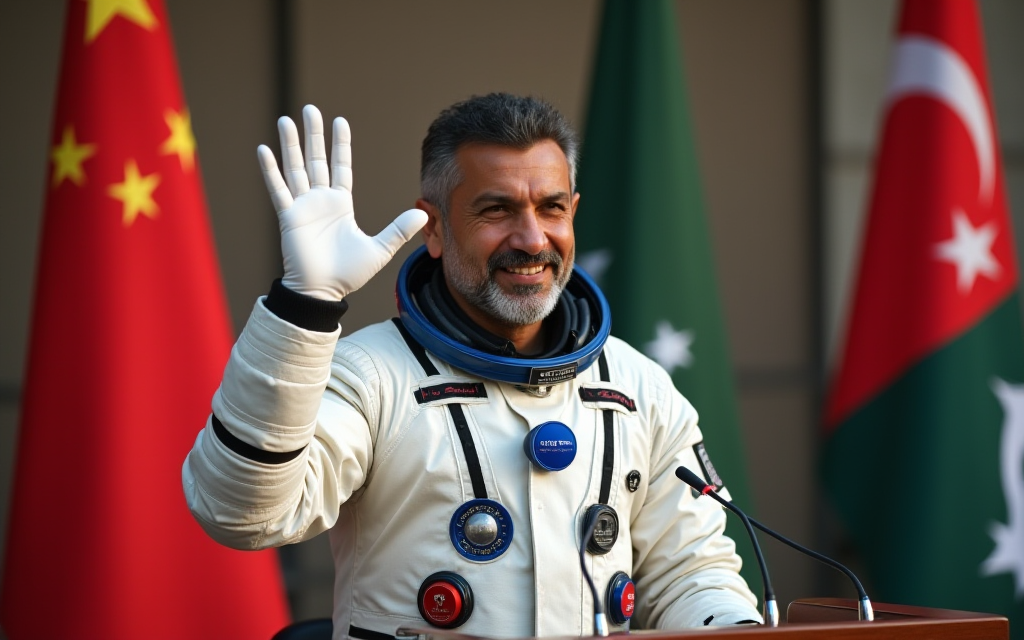
China Sends First Pakistani Astronaut to Space: A New Era of Space Diplomacy
China has launched its Shenzhou-24 mission carrying the first Pakistani astronaut, Muhammad Zeeshan Ali, to the Tiangong space station. This historic mission underscores China's growing space diplomacy and its efforts to internationalize its space program. The collaboration strengthens China-Pakistan ties and signals China's ambition to become a global leader in space exploration, potentially reshaping the future of international space cooperation.
China’s Space Diplomacy Reaches New Heights
In a historic first, China has sent a Pakistani astronaut to its Tiangong space station, marking a significant milestone in international space collaboration. The mission, Shenzhou-24, carried 40-year-old air force pilot Muhammad Zeeshan Ali along with two Chinese astronauts, highlighting China’s growing ambitions in space exploration and its desire to position its space station as a hub for global research.
The Mission and Its Significance
The Shenzhou-24 mission lifted off successfully, and the crew is expected to spend several days aboard the Tiangong space station before returning to Earth. This mission is not only a technological achievement but also a powerful symbol of the deepening ties between China and Pakistan. For Pakistan, having its first astronaut in space is a matter of national pride and a testament to its growing capabilities in science and technology.
China’s decision to include a Pakistani astronaut on this mission underscores its strategy to use space as a tool for diplomatic engagement. By offering opportunities to partner countries, China is positioning itself as a leader in space cooperation, potentially reshaping the global space order.
Strengthening China-Pakistan Relations
China and Pakistan have long enjoyed a close relationship, often described as an “all-weather friendship.” This space mission adds a new dimension to their partnership, which already includes extensive economic and military cooperation. The inclusion of a Pakistani astronaut in a Chinese space mission is a clear signal of China’s commitment to sharing its technological advancements with its allies.
Analysts suggest that this move could strengthen China’s soft power in the region and beyond, as it demonstrates a willingness to collaborate on high-tech ventures. For Pakistan, the mission provides an opportunity to inspire its youth and boost its scientific community, potentially leading to further collaborations in space technology.
Implications for Global Space Collaboration
China’s space station, Tiangong, is designed to be a platform for international research. By inviting foreign astronauts, China is actively promoting its station as a viable alternative to the International Space Station (ISS), which is expected to be decommissioned in the coming years. This mission serves as a proof of concept for China’s ability to host international crews and conduct joint experiments.
The success of this mission could pave the way for more countries to participate in China’s space program, potentially shifting the balance of global space exploration. As China continues to invest heavily in its space capabilities, it is likely to attract more partners, especially from developing nations that may not have access to other space programs.
- First Pakistani astronaut: Muhammad Zeeshan Ali becomes the first Pakistani to visit the Tiangong space station.
- Mission duration: The crew will spend several days in space before returning.
- International collaboration: The mission highlights China’s push for international cooperation in space.
As the world watches, this mission could mark the beginning of a new era in space exploration, one where China plays a central role in fostering global partnerships.
