

India’s Food Inflation Squeezes Households as Prices Surge 8.94%
India's retail inflation rose to 6.09% in October, but food inflation surged to 8.94%, hitting rural and low-income households hardest. Economists blame weather disruptions, supply shortages, and rising input costs. The cost of a basic vegetarian thali jumped 12% year-on-year. While government food programs cushion the blow, weak storage infrastructure and volatile perishable prices remain challenges. A wage-price spiral risk looms, complicating the government's balancing act between farmer support and consumer relief.
Food Inflation Outpaces Overall Inflation in India
India’s retail inflation climbed to 6.09% in October, up from 5.54% in September, according to government data. But the bigger concern is food inflation, which surged to 8.94%, significantly higher than the overall rate. The squeeze was sharper in rural India, where food inflation reached 9.09%, compared with 8.68% in urban areas.
Economists attribute this year’s food inflation to a combination of weather disruptions, supply shortages, and rising input costs. With nearly 60% of India’s farmland dependent on rainfall, the country remains acutely vulnerable to monsoon vagaries. This year, the southwest monsoon was 13% below normal and unevenly distributed, while intensifying El Niño conditions have heightened risks to farm production.
Disproportionate Impact on Low-Income Households
Food accounts for a smaller share of Indian household spending than it once did, but remains the biggest driver of inflation. In the latest consumer price index, food and beverages account for 36.75% of the basket, down from 45.86% under the previous series. Yet a sharp increase in food prices can move overall inflation significantly, while disproportionately affecting people with limited incomes.
“Adjustability for a poor country like India is significantly lower,” says Rajeswari Sengupta, an associate professor of economics at the Indira Gandhi Institute of Development Research in Mumbai, pointing to the substantial proportion of household income still spent on food.
According to calculations by Dharmakirti Joshi, chief economist at Crisil, the bottom 20% of rural households faced inflation of 6.9% in October, against 6.5% for the richest 20%. In urban India, the corresponding rates were 6.1% and 5.3%.
The pressure is visible even in the cost of a simple meal. Crisil’s Roti Rice Rate analysis found that the cost of a home-cooked vegetarian thali rose 12% year-on-year in October, driven by higher prices of onions, tomatoes, vegetables, edible oil, rice, and cooking gas. A non-vegetarian thali became 9% more expensive.
Rice prices were up about 10% year-on-year, pulses 8%, edible oil 13%, and LPG 10%, according to Pushan Sharma, director of intelligence at Crisil. “It’s no longer a few commodities that are driving this increase, it’s becoming a little more broad-based,” he says.
Supply Chain Weaknesses and Volatile Perishables
Food inflation is not just about what farmers produce. It is also about how efficiently that food is stored, processed, and moved to market. Weaknesses at each stage can turn seasonal shortages into sharp price spikes—and gluts into waste.
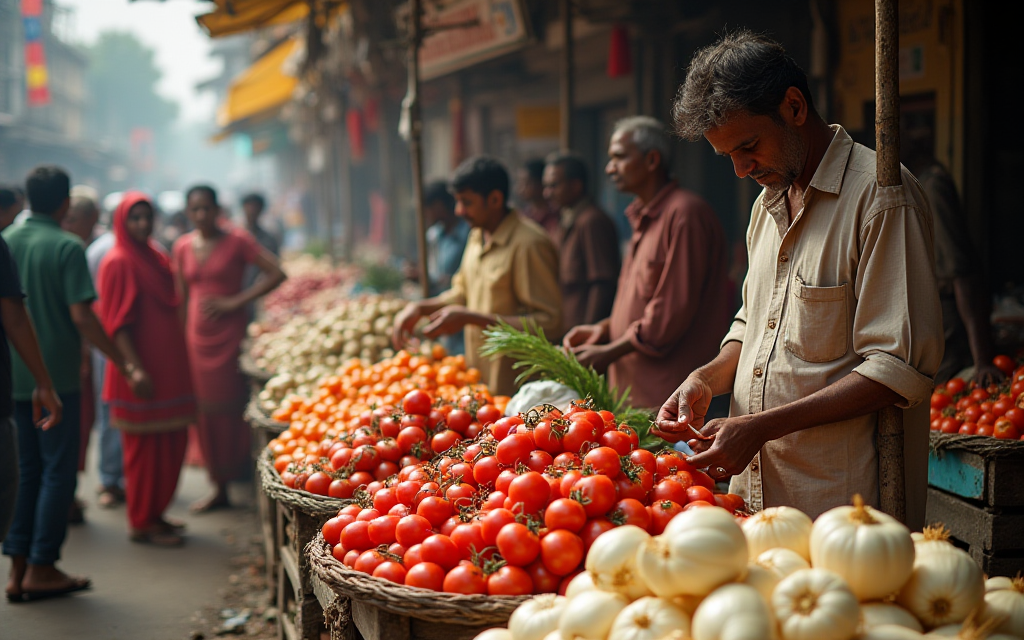
Onions, for instance, are particularly susceptible to seasonal price swings. The rabi crop, which accounts for roughly two-thirds of onion production, is harvested in March and April and stored for several months. As stocks dwindle, prices can rise sharply before the next crop arrives. Tomatoes tend to see price spikes during summer months when arrivals decline or heat stress affects production.
Sharma says perishables are often responsible for sudden spikes in food inflation, while prices of staples such as rice and wheat tend to rise more gradually but can stay higher for longer. “The perishables are what caused the volatility. The non-perishables, like rice and wheat, are the ones that structurally increase the cost,” he says.
Economists say India still lacks adequate infrastructure to sort, grade, store, and process much of its perishable produce. Tomatoes, for example, can become so abundant during a glut that farmers struggle to sell them at remunerative prices, only for consumers to face sharply higher prices months later. Better storage and processing could help turn some of that surplus into products such as puree, smoothing the extremes between abundance and scarcity.
There are other pressures. Energy shocks feed into the cost of transport, irrigation, and agricultural inputs. Fertiliser prices can rise. Global edible-oil markets matter because India relies heavily on imports.
Government Cushions and Wider Economic Risks
India has some protection against the worst effects of food inflation. Government stocks of cereals are comfortably above prescribed minimum levels, and the free-food programme covering nearly 800 million people offers a cushion against rising prices. Rice stocks are particularly ample.
But there is a wider economic risk, says Sengupta. “Food inflation may begin with a supply shock, but its effects can spread. Workers who find that their wages no longer cover basic living costs may seek higher pay. Businesses facing higher labour costs may raise prices. What begins as a rise in the price of food can gradually become a more general inflationary pressure—the familiar wage-price spiral that central banks try to prevent.”
For India, this creates a particularly difficult balancing act. Agriculture is a relatively low-productivity sector, and the government has long sought to protect farmers by setting minimum support prices for certain crops. At the same time, food prices are politically sensitive. Sharp increases in the price of staples such as onions and tomatoes can quickly anger consumers, prompting governments to step in with measures such as restricting exports, limiting how much traders can stockpile, or otherwise trying to bring prices down.
The broader story of India’s changing food consumption makes the current inflation more interesting. Households are eating differently from a decade ago. An analysis of the 2011-12 and 2023-24 consumption surveys shows that the share of cereals in food spending has fallen sharply, particularly among the poorest households, reflecting the impact of subsidised food programmes. Meanwhile, consumption of nutrient-rich foods such as dairy, fruit, and meat has increased across income groups, with the biggest gains among the poorest.
India’s food basket is becoming more diverse. But diversity is meaningful only if ordinary Indians can afford it. Ultimately, food inflation is about what makes it to the plate—and what has to be left out.
