

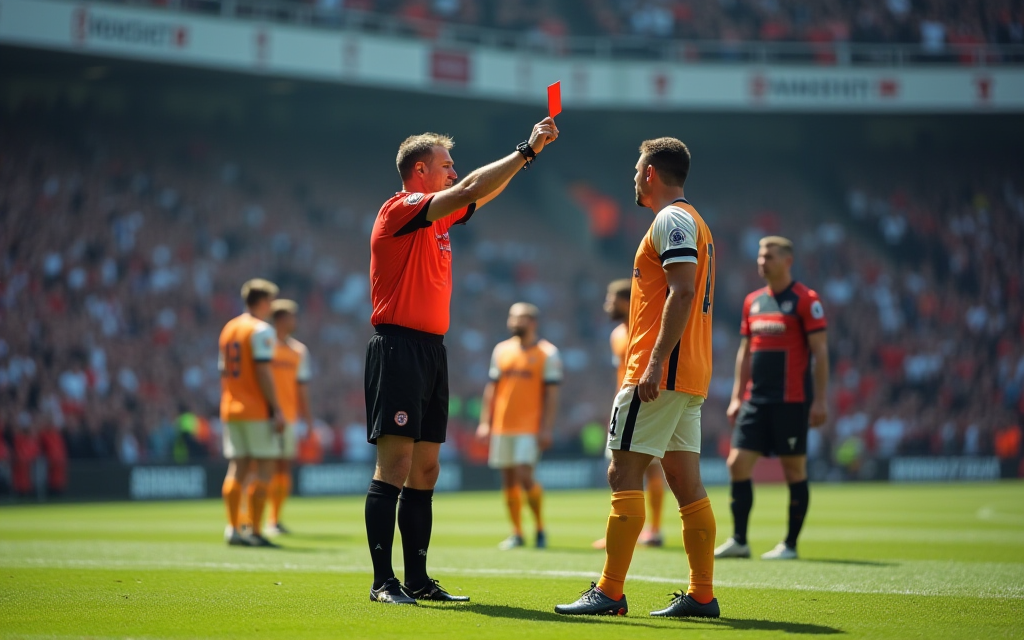
Leny Yoro Red Card Rescinded but Manchester United and Pro Ref Clash Over VAR
Manchester United's appeal against Leny Yoro's red card at Liverpool has been successful, but the row with referees' body Pro Ref continues after Howard Webb insisted the decision was not 'clearly wrong.' The incident has sparked debate over VAR thresholds and the FA appeal process, with United arguing data proves Isak wouldn't have reached the ball. Pro Ref maintains the original call was not an egregious error, highlighting the ongoing tension between clubs and refereeing authorities.
Manchester United’s Leny Yoro sees red card overturned, but dispute with referees’ body Pro Ref escalates
Manchester United’s appeal against Leny Yoro’s red card in the 4-0 defeat at Liverpool has been successful, with the Football Association (FA) regulatory commission overturning the decision. However, the row has intensified after Pro Ref boss Howard Webb insisted the original red card was not “clearly wrong,” just moments before United’s pre-match news conference on Tuesday.
The incident occurred in the eighth minute at Anfield when Yoro brought down Liverpool striker Alexander Isak. Referee Sam Barrott sent off the French defender, and VAR John Brooks upheld the decision. The call split opinion among pundits and fans, with debate over whether Isak would have reached the ball before goalkeeper Senne Lammens and whether it was a clear goalscoring opportunity.
Pochettino’s frustration and United’s sense of injustice
United head coach Mauricio Pochettino was fiercely critical of the decision, particularly the VAR’s cursory review. “You ask me a question and I need to defend our situation and our club and our players,” Pochettino said. His comments continued a theme from his post-match news conference, where he seemed keen to create a siege mentality after losing his first game in charge.
United’s frustration is understandable given that two of their biggest games this season have been defined by refereeing decisions. Earlier, a VAR error allowed Erling Haaland’s match-winning goal in the Manchester derby when Enzo Fernandez clearly committed an offside offence. For the Yoro incident, United felt the VAR only took a cursory look at where the ball would run.
Pro Ref’s stance and the VAR threshold debate
Howard Webb’s comments on Match Officials Mic’d Up, filmed on Monday evening before the appeal result, highlighted Pro Ref’s belief that the red card was not an egregious error requiring VAR intervention. Webb acknowledged the argument that Isak would not have reached the ball but remained adamant that the threshold for VAR involvement was not met.
This raises the question: are we back to arguing about when VAR should get involved? The VAR threshold is too high until it is too low—a never-ending cycle. It is the Premier League clubs, not Pro Ref or the FA, who set the bar. A recent stakeholders’ survey found 65% wanted to maintain the current threshold for VAR intervention, 20% to increase it, and just 15% to lower it. Yet where the Yoro incident sits remains a matter of opinion.
How the FA appeal system works and why Pro Ref disagrees
An FA regulatory commission has said the red card decision was wrong, but Pro Ref will not always agree with an appeal board’s decision, nor use it as a barometer for future decisions. The burden of proof for a VAR intervention is considered higher than for an FA commission. Pro Ref places far more stock upon the judgements of the Premier League’s Key Match Incidents (KMI) Panel, which creates the merit table for referees and helps shape future decisions, especially for VARs.
The FA is responsible purely for disciplinary measures and has no say on how games at the professional level are refereed. If the Premier League tells Pro Ref the decision is right or wrong, that counts far more than any vote by an FA commission.
So how did United make their case? BBC Sport understands the club argued that if Isak had maintained his top recorded speed, he would not have got to the ball first. The club say that is objectively provable within minutes using data, and thus not a subjective decision. However, to argue it was not subjective goes against the nature of the decision—it required a referee’s judgement. Whatever data United used, it was not available to the referees; the VAR cannot call upon a 3D animation of each player detailing running speed and providing an objective result.
How much stock the commission placed on this evidence will be revealed when the written reasons are published in a few days. But United are not going to let this lie, and Pro Ref is not going to bend.
The unpredictable nature of FA commissions
FA commissions consist of three panel members, usually former players but occasionally a retired referee. Their role is not to “usurp the referee by re-refereeing the incident.” A designated referee delegate is present to answer questions on the laws of the game but cannot offer an opinion on the incident. Pro Ref’s only input is the official’s report—a short entry by the referee stating which law was used for the red card. There is no other context.
The burden is on the club to prove its case by submitting a body of evidence—videos, images, and testimony. There is no right of reply. The evidence is weighed up by the panel, a vote is cast, and the majority wins. This makes predicting outcomes notoriously difficult, as the system is essentially an opinion poll based on a club trying to persuade at least two people to agree with them.
Take Aston Villa’s successful appeal against Douglas Luiz’s red card for violent conduct four years ago. Luiz had been sent off via a VAR review for a headbutt on Aleksandar Mitrovic. The panel’s written reasons stated the appeal was won partly because Luiz was “a few inches shorter than Mr Mitrovic so his forehead is naturally at the same height as Mr Mitrovic’s nose/face as the two players come together.” So, when the two players bumped chests, the headbutt was just an accident. Appeal upheld because Luiz was a bit shorter.
Some might think anything is worth trying. As the row continues, the spotlight remains on the VAR system and the ongoing tension between clubs and refereeing authorities.
