

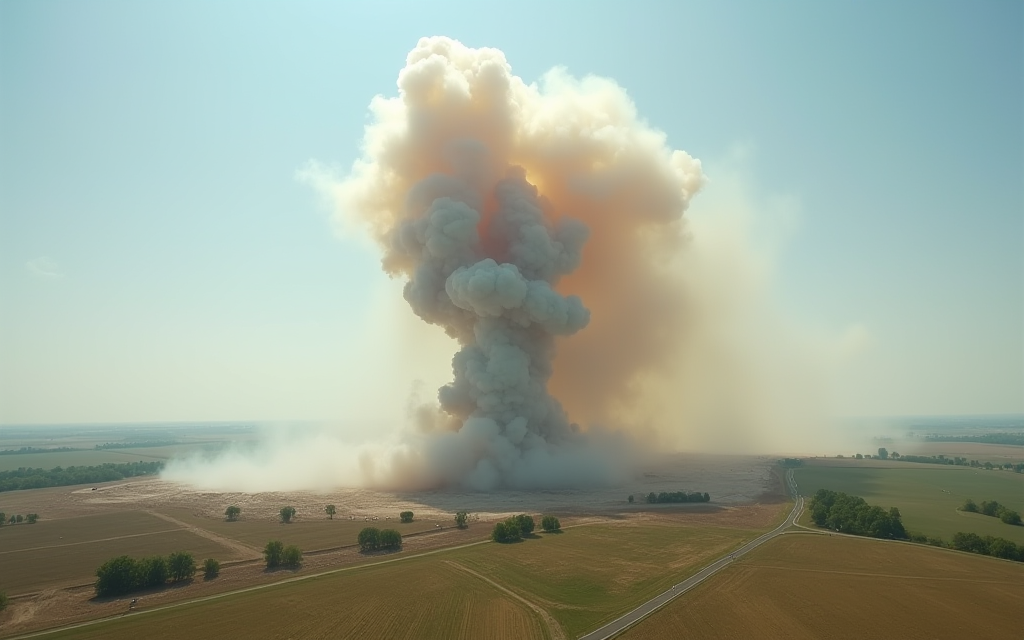
US Army Hails Controlled Detonation of Toxic Explosives in Iowa as ‘Huge Success’
The US Army has called the controlled detonation of nearly five tonnes of toxic explosives in Iowa a 'huge success,' despite public fears and legal challenges. Officials say the risk was near zero, and initial EPA readings show no elevated lead levels. Residents reported feeling and seeing nothing, but some leaders call for continued testing and transparency.
US Army Declares Controlled Detonation of Toxic Explosives in Iowa a ‘Huge Success’
The US military has declared the controlled detonation of nearly five tonnes of toxic explosives in Iowa a “huge success,” despite widespread fears over health and environmental risks. The explosion, which sent smoke billowing into the sky shortly after 09:00 local time on Wednesday, was described by Army officials as posing a risk “as close to zero as is absolutely humanly possible.”
President Donald Trump said reports showed mitigation efforts “far exceeded expectations.” The operation had been paused multiple times due to public outcry and legal challenges before proceeding on Wednesday.
Background: Unstable Explosives and Public Concerns
The explosives, stored for around 20 years, had degraded through a process called recrystallisation, making them highly volatile and at risk of accidental detonation from friction or movement. The compound, lead azide, is particularly dangerous, and its disposal raised significant concerns among residents of Middletown, Iowa, and surrounding areas.
Lead exposure is known to be harmful even at low levels, with children and pregnant women especially vulnerable. The Army had warned locals of “potential exposure to toxic lead dust,” leading to panic and an optional evacuation zone and shelter-in-place advisory.
Legal challenges were mounted to halt the detonation on environmental and health grounds. However, on Monday, an appeals court overturned a decision to block the blast, citing that the risk of an unplanned explosion was greater than the controlled detonation.
Community Reaction: Relief and Caution
Middletown Mayor Rodney Johnson expressed relief and vindication after the detonation. Watching from his workplace eight miles away and monitoring a camera at his home just one mile from the site, he reported feeling and seeing nothing. “We did not feel anything. We did not see anything,” Johnson said.
Sandy Mabeus, who lives eight miles from Middletown, hunkered down with her family, closing windows and bringing their outdoor cat inside. They watched live streams of the explosion. “We did not feel or hear a thing here,” she told the BBC. “The waiting and wondering has not been a good thing for anybody in the area. Hopefully they had a very good result and we can just get on with things.”
Iowa farmer David Vandenberg, about 20 miles from the blast site, heard a rumble but saw or smelled nothing. He expects officials to return for more samples but was happy the blast was relatively contained. “I think the effects will be minimal,” he said.
However, caution remains. Iowa’s incoming Governor-elect Rob Sand called for “immediate transparency” and said there is “more testing to do.” He emphasized that any Iowans impacted must be taken care of fully and right away. FEMA Administrator Cameron Hamilton said additional resources and testing would be provided in the coming days and weeks.
Environmental Monitoring and Next Steps
Acting Secretary of the US Army Adam Telle wrote on social media that the detonation exceeded all expectations and was a “HUGE success.” He noted that the Environmental Protection Agency’s sensor array showed no readings above 0.0 so far.
Despite the positive initial reports, ongoing monitoring and testing will be crucial to ensure the safety of the community and the environment. The Army has faced pushback from residents and politicians alike, and the call for transparency underscores the need for clear communication about the operation’s aftermath.
As the community begins to recover, the focus will shift to verifying that the controlled blast indeed posed minimal risk and to addressing any lingering concerns about lead exposure and environmental contamination.
