

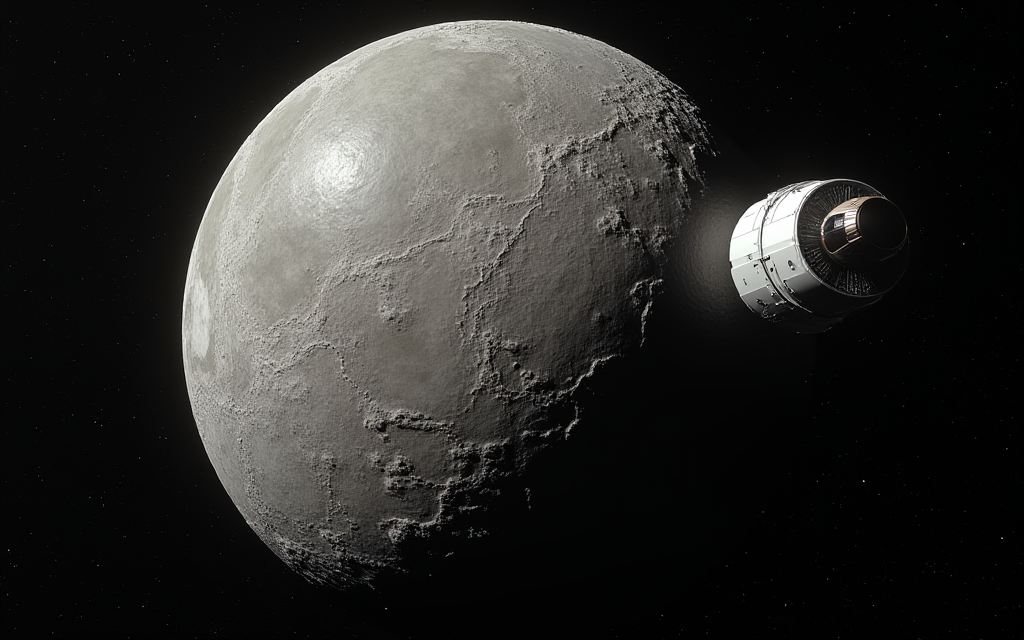
BepiColombo Arrives at Mercury After 8-Year, 10-Billion-Km Journey
The ESA-JAXA BepiColombo spacecraft has successfully entered orbit around Mercury after an eight-year, 10-billion-km journey. The mission aims to solve mysteries such as ice in polar craters, strange hollows, and the planet's massive metal core. The spacecraft will soon separate into two orbiters to study Mercury's surface and magnetosphere.
BepiColombo Enters Mercury Orbit After Epic 8-Year Voyage
After an eight-year journey covering almost six billion miles (10 billion km), the joint European-Japanese BepiColombo spacecraft has successfully entered orbit around Mercury. The mission, a collaboration between the European Space Agency (ESA) and the Japan Aerospace Exploration Agency (JAXA), launched in 2018 and has finally reached its destination to unravel the mysteries of the solar system’s smallest and least-explored planet.
A Perilous Arrival
Mercury is an extremely hostile environment, with temperatures soaring to 430°C and plunging to -180°C, all while being bombarded by intense solar radiation. To enter orbit, BepiColombo had to perform a 37-minute handbrake turn, allowing the planet’s gravity to capture it. The European Space Agency confirmed on X that the probe made contact and telemetry data verified it is now flying around the planet. However, a software issue caused the thrusters to fire for a shorter time than planned, adding a tense moment to the already risky maneuver.
The journey itself was extended by a year due to a problem with the spacecraft’s propulsion system. BepiColombo had to take a convoluted path, looping once around Earth, twice around Venus, and six times around Mercury to slow down enough to be captured by Mercury’s gravity. This complex trajectory was necessary to counteract the Sun’s immense gravitational pull.
Unlocking Mercury’s Mysteries
Mercury has been visited by only two spacecraft so far—NASA’s Mariner-10 in the 1970s and Messenger, which orbited from 2011 to 2015. Yet many questions remain. BepiColombo aims to solve some of the planet’s biggest puzzles, including why there is ice in its polar craters despite its proximity to the Sun, and the nature of the mysterious hollows dotting its surface.
These hollows are shallow depressions with steep sides, often clustered together, and are relatively young—about 100,000 years old. Scientists know they are not impact craters, but their origin remains unknown. “I think it’s a little bit of an under-loved planet in the inner Solar System, but I think that’s one of the reasons why it is so compelling,” said Prof Emma Bunce from Leicester University, a principal investigator on the mission. “There are lots of reasons, scientifically, why we really want to understand Mercury, how it formed, how it evolved, what it looks like today, but also how it interacts with the Sun and the extreme space weather that it experiences.”
Another enigma is Mercury’s massive metal core relative to its small size. One hypothesis is that the planet was once much larger but lost its outer layers in a giant collision early in its history. Alternatively, it may have formed in a metal-rich region of the early solar system.
Two Spacecraft in One
BepiColombo is unique in that it carries two orbiters. A few weeks after arrival, the spacecraft will separate: ESA’s Mercury Planetary Orbiter will study the surface up close, while JAXA’s Mercury Magnetospheric Orbiter will observe the planet from a distance. The separation is a delicate operation, as the two craft have been securely attached for eight years and exposed to harsh space conditions. “We have designed a special mechanism that we have thought very carefully about,” said Jessica Marshall, a systems engineer at Airbus, which built the spacecraft. “It’s been exposed to the harsh radiation of space and highly different thermal temperatures, and after eight years this is a spring mechanism that has to then release very gently… As it releases, it actually also twists in order to start the spin of that spacecraft as well.”
A life-size model of BepiColombo is on display at the Science Museum in London, showcasing the mission’s complexity. With two orbiters packed with instruments, the team hopes to find answers to Mercury’s mysteries—and perhaps uncover new ones.
