

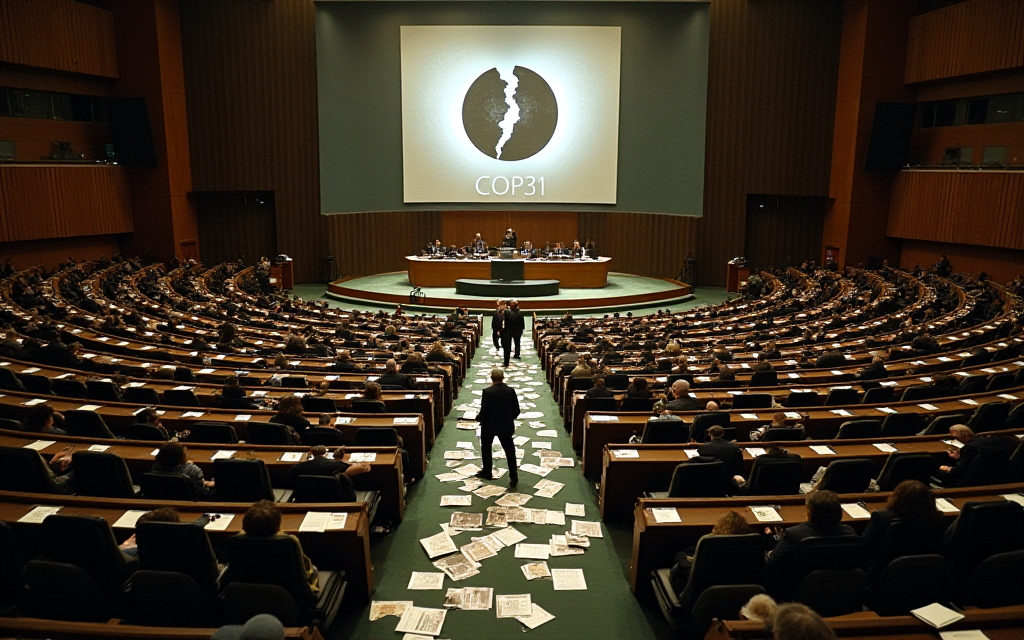
COP31 Fails to Deliver Central Agreement: Five Key Takeaways from the Antalya Climate Talks
The COP31 climate summit in Antalya, Turkey, ended without a central political agreement, marking the longest-running UN climate talks in history. Deep divisions over fossil fuels and finance prevented consensus, despite clear evidence of accelerating climate change. The failure raises urgent questions about the future of the COP process, even as renewable energy growth accelerates and some technical agreements are reached. Here are five key takeaways from the failed talks.
COP31 Ends Without Central Political Agreement
The COP31 climate summit in Antalya, Turkey, concluded without a central political agreement, marking the longest-running climate talks in UN history. Despite clear evidence of accelerating climate change—including glacier collapses, record European heat, and wildfires across Asia—geopolitical divisions prevented consensus on the Antalya Pacts, which aimed to further climate action. Co-hosts Australia and Turkey struggled to bridge divides, and a fractious final day saw countries walk out over the absence of fossil fuel language and financial disputes. The failure raises serious questions about whether the COP process can still deliver effective global climate action.
Five Critical Takeaways from the Failed Talks
1. The World Prepares for Life Beyond 1.5°C
For the first time, a COP took place after the UN warned that global temperatures are expected to exceed 1.5°C above pre-industrial levels—the threshold set by the 2015 Paris Agreement. The draft agreement had acknowledged this overshoot, but without a final deal, that recognition was lost. The IPCC has warned that a 1.5°C rise versus 2°C would mean 10 cm higher sea levels, exposing 10 million more people to flooding, more acidic oceans, and extreme heat in every inhabited region. The draft also proposed carbon dioxide removal (CDR) for the first time, a controversial technological solution. Despite the failure, many countries reaffirmed 1.5°C as their north star, but the absence of formal acknowledgment leaves the target politically weakened.
2. Deep Divisions Over Fossil Fuels and Finance
The talks exposed a troubling erosion of consensus. Countries could not agree on including language on fossil fuels, despite a pledge made just three years ago at COP28 in Dubai. Rich nations also failed to specify how much more money would be provided to developing countries for adaptation, even though a commitment to triple adaptation finance by 2035 from $40 billion exists—interpretation remains contested. The final meeting saw sharp exchanges: the EU accused oil states of hijacking the talks, while Russia accused the EU of providing climate finance only as loans, calling it “an old colonial distribution of labour under a new banner.” Australia’s co-lead minister noted the “most complicated and fraught geopolitical environment in living memory.” The failure is a blow not only to climate action but to multilateralism itself.
3. Some Progress Amidst Disappointment
While the central political agreement failed, negotiators did reach agreement on 164 other agenda items. Funds from a global carbon credit system will go toward helping developing countries adapt to climate impacts. Countries also agreed to advance a just transition framework to protect workers and communities as economies shift to clean energy. However, many items remain unresolved, including the crucial work programme for driving emissions cuts, which will be picked up at COP32. The mixed outcome highlights that while technical cooperation continues, political consensus on the core issues is fraying.
4. Renewable Energy Growth Is Unstoppable
Despite the diplomatic failure, the energy transition is accelerating. The International Energy Agency’s World Energy Outlook points to energy security as a powerful driver: disruption to oil and gas supplies through the Strait of Hormuz has been the biggest energy supply shock in history, incentivizing countries to switch to domestically generated electricity. Solar panels, batteries, and electric vehicles have become increasingly competitive. Renewable capacity is expected to grow 60% more over the next six years than in the previous period. IEA head Fatih Birol told the BBC: “We are not entering the age of electricity, we have arrived at the age of electricity.” While formal negotiations may become less important for determining the pace of transition, governments still play a crucial role in removing policy barriers around infrastructure and permitting, according to business leaders.
5. The COP Process Needs Reform
COP31 has shown that the role of annual UN climate conferences is shifting. The first 30 COPs focused on building the international framework—from the Paris Agreement to the Glasgow Pact and beyond. That architecture is now largely built. The emphasis must shift to implementation, making COP more procedural and less about fundamental negotiations. This could mean doing away with a central cover text, which is not a requirement. Australia pushed for one this year and failed. As Camilla Born, who helped develop the UK’s COP26 strategy, noted, the focus is now on ensuring the machinery works. The failure in Antalya underscores the need for reform so that COP can deliver coordinated climate action even in a fractured geopolitical landscape.
