

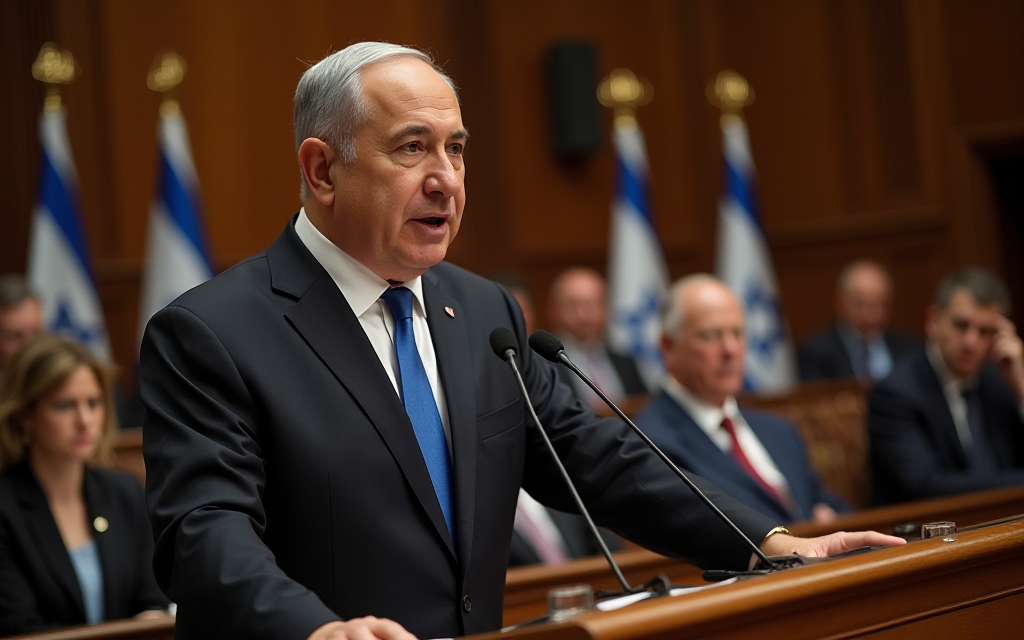
Israeli Judges Recommend Dropping Bribery Charges Against Netanyahu in Corruption Trial
Israeli judges have recommended dropping bribery charges against Prime Minister Benjamin Netanyahu in one of three corruption cases, citing low conviction chances. The panel also questioned criminal conduct in a second case and suggested a plea deal in a third. Netanyahu, who denies all allegations, called for an immediate end to the trial. The development comes as rival Gadi Eisenkot attempts to form a coalition government after an inconclusive election, potentially boosting Netanyahu's political survival.
Israeli Judges Recommend Dropping Bribery Charges Against Netanyahu
In a significant development in Israeli politics, a panel of judges at the Jerusalem District Court has recommended that prosecutors drop the most serious bribery charges against caretaker Prime Minister Benjamin Netanyahu. The recommendation, announced on Wednesday, comes as Netanyahu fights for his political survival amid ongoing coalition negotiations.
The judges expressed doubts about the chances of conviction in the first of three corruption cases, known as Case 4,000, which alleges a reciprocal arrangement between Netanyahu and a controlling shareholder in Israel’s largest telecoms company. They also questioned whether his actions in a second case, Case 2,000, met the threshold for criminality, and suggested prosecutors seek a plea deal in the third case, Case 1,000.
Details of the Cases and Judicial Concerns
Case 4,000 centers on allegations that Netanyahu granted regulatory favors to Bezeq, Israel’s largest telecoms company, in exchange for positive coverage on its news site Walla. Both Netanyahu and the company’s controlling shareholder, Shaul Elovitch, have denied any wrongdoing. The judges told Attorney General Gali Baharav-Miara that “the chances of conviction are low – to an extent that warrants reconsidering the matter,” according to Israeli media reports.
In Case 2,000, Netanyahu is accused of conspiring with Arnon Mozes, publisher of the Yedioth Ahronoth newspaper, to weaken a rival publication in exchange for favorable coverage. The judges cast doubt on whether Netanyahu’s actions amounted to criminal conduct. Case 1,000 involves allegations that Netanyahu received gifts, including cigars and champagne, from Australian billionaire James Packer and acted in his favor. The judges left open the possibility of a conviction in this case but called for a “rethink” in how the trial should proceed in the public interest.
Netanyahu, who has consistently denied all allegations, welcomed the judges’ remarks. In a televised statement, he said, “Ten years of terrible suffering for me, my family, my son. Ten years of incitement to hatred that wounds the soul,” and called for the trial to be ended “immediately.” He has long claimed to be the victim of a political witch-hunt.
Political Implications and Next Steps
The judges’ recommendation is a potential boost for Netanyahu, whose political future hangs in the balance. His opponent, Gadi Eisenkot, is currently attempting to form a coalition government after last month’s inconclusive general election. While Netanyahu’s parliamentary bloc won more seats, both fell short of an outright majority, and President Isaac Herzog has tasked Eisenkot with the first opportunity to form a government.
The corruption trial has deeply divided Israeli politics and coincided with controversial judiciary reforms by Netanyahu’s government. For his opponents, Netanyahu’s fear of prison has distorted his decision-making and made him dependent on far-right coalition partners. The latest development may strengthen his position as he seeks to retain power.
Attorney General Baharav-Miara said she would consider the judges’ recommendations. It remains unclear whether prosecutors will heed the advice, but the judges’ intervention is highly unusual and signals serious doubts about the cases. Netanyahu also faces an arrest warrant from the International Criminal Court for alleged war crimes in Gaza, which he denies.
The trial, which began in 2019, has been prolonged by the Israel-Gaza war. With the judges’ recommendation, the legal and political landscape may shift, potentially altering the course of Israel’s leadership. As coalition talks continue, the outcome of the corruption cases will undoubtedly influence the country’s future.
