

Sheikh Hasina’s Planned Return to Bangladesh on Victory Day Raises Tensions with India
Sheikh Hasina, Bangladesh's ousted prime minister sentenced to death in absentia, plans to return on December 16, Victory Day. The government vows to arrest her, while India faces a diplomatic dilemma over sheltering its former ally. Her announcement has escalated political tensions and unrest, with the banned Awami League exploiting divisions to re-enter the political fray.
Sheikh Hasina’s Announced Return Puts Bangladesh on Edge
DHAKA, Bangladesh — Ousted Prime Minister Sheikh Hasina has declared she will return to Bangladesh on December 16, Victory Day, setting up a potential confrontation with the government that has sentenced her to death and vowed to arrest her immediately upon arrival.
Hasina, 79, fled to India in August 2024 after a student-led uprising ended her 15-year rule. She was later convicted of crimes against humanity in absentia for her role in the crackdown that, according to the United Nations, killed as many as 1,400 people.
Her announcement, made through a spokesperson, has prompted the Bangladeshi government to insist she must be extradited, while India says it is examining the request through established processes.
Government Vows Arrest, Extradition Demand
Bangladesh’s state minister for foreign affairs, Humaiun Kobir, dismissed any notion of a voluntary return, telling reporters in Dhaka: “Reality and desire are different things. She’s not a regular commercial passenger. She can only be brought back in handcuffs.”
The government has promised to carry out the death sentence if Hasina returns. Her Awami League party is banned, and many of its leaders are abroad, in jail, or underground.
Hasina’s aide, Abu Obaidha Arin, told the BBC that she is prepared to travel commercially or even cross the land border on foot if no flight is arranged. He said supporters have identified nine possible crossing points, calling it “a carefully thought-out, precise plan.”
Political Calculations and Unrest
The date is symbolic: Victory Day marks Bangladesh’s triumph over Pakistan in the 1971 liberation war, and Hasina is invoking it to reclaim her place in the nation’s founding narrative.
Analysts say her announcement is also an attempt to test the government’s authority and exploit divisions among the parties that united to oust her. The Awami League has remained active through Telegram audio meetings—more than 300 over 18 months—reaching supporters across all 64 districts, according to Arin.
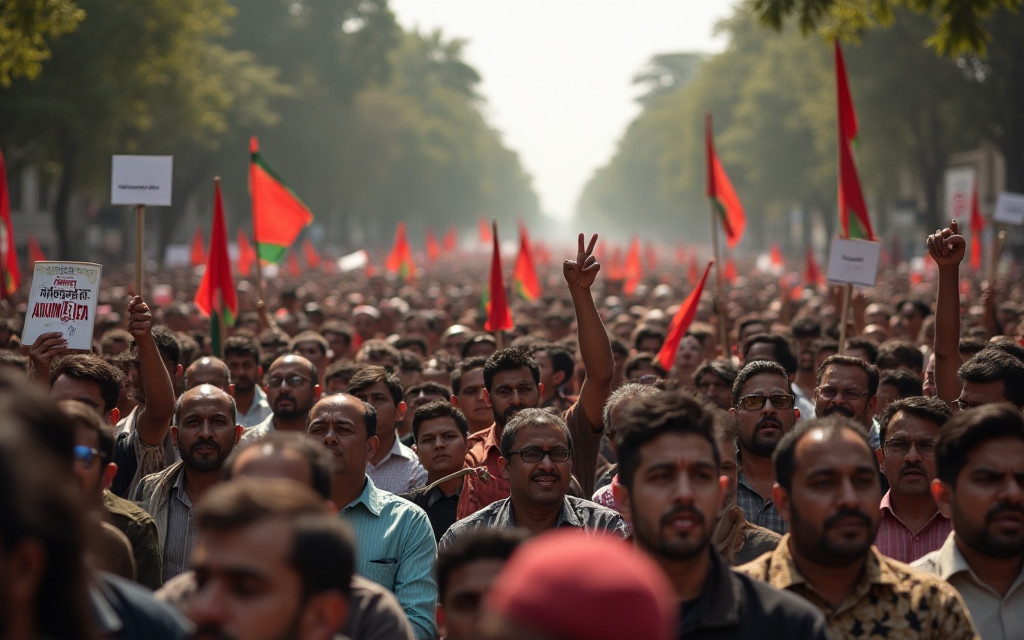
Recent months have seen flash protests and violence in several districts, including Hasina’s ancestral Gopalganj, where supporters have attacked police stations and blocked highways. Conflict monitoring group Acled reports 40 demonstrations and more than 140 riots up to November 23, with at least 11 killed in political violence this month.
“The Awami League sees an opening,” said Shafiqul Alam, editor of the Daily Waadaa and former press secretary to the interim government. “The party believes this is an opportune moment to take to the streets, exploiting a weakened police force and divisions among the forces of the July uprising.”
India’s Dilemma and Strained Ties
India has sheltered Hasina but her public remarks have angered Dhaka, which wants her extradited. Relations remain strained: nearly 10 months into his tenure, Prime Minister Tarique Rahman has yet to visit India.
Avinash Paliwal, a politics professor at SOAS University of London, argues that Hasina’s announcement has “shifted the burden of choice to Dhaka rather than Delhi.” He said India feels it has tried its best to work with Rahman’s government, but the failure of outreach has left Delhi disillusioned.
“India seems to have decided that bilateral relations will likely remain tense whatever it does, so there is little reason to stop Hasina from stirring the political pot,” Paliwal said.
The larger question, analysts say, is whether Bangladesh can sustain the exclusion of a political constituency as substantial as the Awami League without creating another source of instability.
