

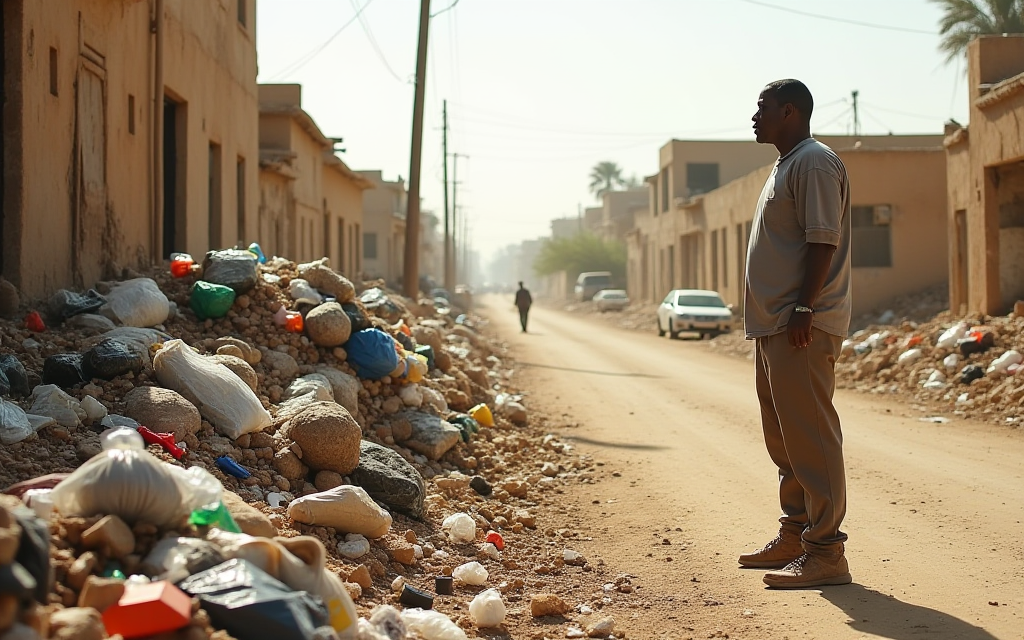
Sudan Launches 50-Day Cleanup as Rubbish Crisis Threatens Khartoum Returnees
Sudan’s government has launched a 50-day sanitation campaign to clear rubbish from Khartoum’s streets after war destroyed most waste collection services. Residents and health experts warn that temporary cleanup efforts are insufficient as piles of garbage breed disease and residents burn trash, releasing toxic fumes. The capital has seen 2.88 million returnees since the army recaptured it in 2025, but basic services remain crippled.
Sudan Launches 50-Day Cleanup as Rubbish Crisis Threatens Khartoum Returnees
KHARTOUM, Sudan — Sudan’s government has launched a 50-day sanitation campaign to clear mountains of rubbish from Khartoum’s streets, as returning residents face a growing public health crisis caused by the collapse of waste collection services during the country’s civil war.
The campaign, announced this month, involves government institutions, ministries, and civil society groups. It aims to remove accumulated waste and rehabilitate damaged equipment, but residents and experts warn that temporary cleanup efforts will not be enough without sustained investment in public services.
Waste Crisis Grips the Capital
When Musa Abdelrahman, 54, returned to Khartoum from Egypt in March, he found a city where basic services had been decimated. Rubbish collection trucks no longer reach most residential neighborhoods, and piles of garbage have turned streets into open dumps.
“The problem is not just about how the city looks; it has started affecting our daily lives,” Abdelrahman told Al Jazeera. “We want to live in a clean environment, with waste collection trucks operating regularly.”
Khartoum State Cleaning Cooperation says 90 percent of its sanitation and waste transportation fleet has been lost to theft or damage during the war. That includes 127 smaller collection vehicles and approximately 9,000 large waste containers previously deployed across markets, neighborhoods, and public squares.
Refuse worker Saeed Koko said collection services now mainly operate in major markets, leaving many residential areas without regular pickup. “We need more waste collection vehicles, equipment and workers,” Koko said.
Health Risks Mount as Residents Burn Trash
With collection services disrupted, many residents have resorted to burning piles of rubbish, releasing toxic fumes into the air. Sawsan Omar, a resident of Omdurman, said the smells and smoke often force families to keep windows closed.
“What worries us most is the impact on children and older people,” Omar said. “We appeal to the authorities to provide waste collection trucks and containers in residential neighborhoods.”
Dr. Al-Fatih Mahmoud, a public health specialist, warned that repeated exposure to toxic fumes and pollutants poses long-term health risks, including respiratory irritation, asthma, and bronchitis. He also noted that accumulated waste creates breeding grounds for flies, mosquitoes, and rodents, increasing the risk of gastrointestinal diseases such as cholera and typhoid, as well as insect-borne illnesses like dengue fever and malaria.
“The continued accumulation and burning of waste in residential neighborhoods constitute a public health threat that requires urgent intervention,” Mahmoud said.
Government Response and Challenges Ahead
The 50-day campaign is overseen by a committee headed by Mineral Resources Minister Nour al-Daem Taha. He said central government institutions will support the state’s efforts, mobilize resources, and rehabilitate machinery where possible.
Separately, Japan and the Japan International Cooperation Agency, in partnership with UN-Habitat, announced a $4.5 million project on November 4 to help clear rubble in Khartoum State. There are also efforts to remove wrecked and abandoned vehicles from roads.
But political analyst Ali Mansour Hasballah said restoring public services requires more than temporary campaigns. “It requires rehabilitating public service institutions, providing resources and equipment, restoring the workforce, and developing sustainable plans to ensure that services reach all neighborhoods,” he said.
Residents fear the campaign will focus on high-profile areas and neglect poorer neighborhoods. “It must also reach residential neighborhoods and side streets, where people suffer daily,” Omar said. “We want to see tangible results that continue even after the campaign ends, rather than a temporary effort lasting only 50 days.”
About 2.88 million people had returned to Khartoum State by October 28, 2026, according to the government, the highest number among Sudan’s states. The war, which broke out in April 2023 between the Sudanese Armed Forces and the Rapid Support Forces, has displaced about nine million people and created one of the world’s worst humanitarian crises.