

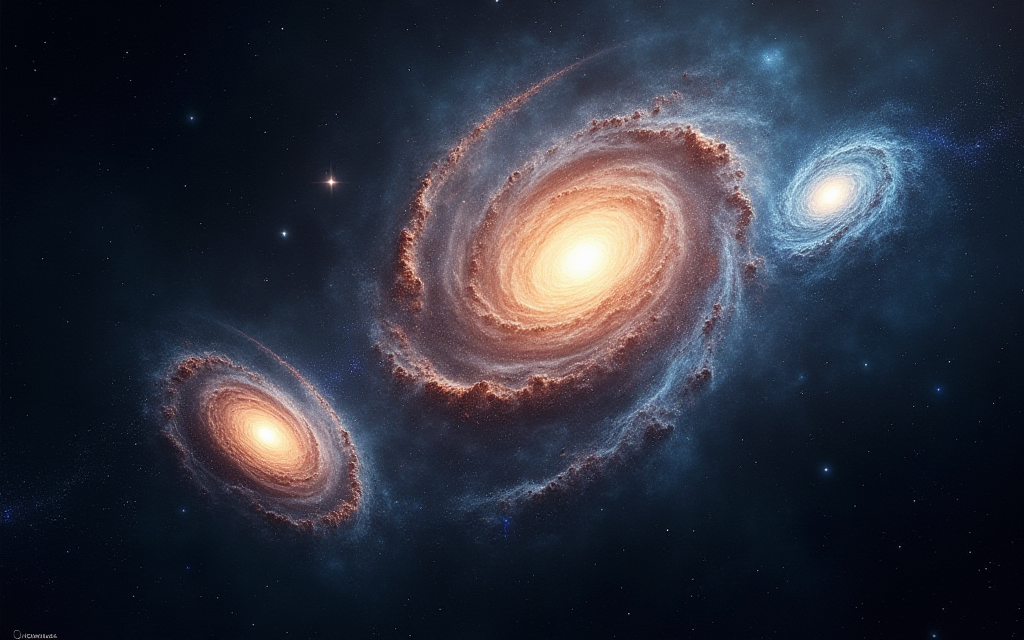
Galaxies Battle in the NGC 7771 Group: NASA’s APOD Captures Cosmic Clash
NASA's APOD for November 24, 2026, showcases the NGC 7771 Group, a dramatic collision of galaxies 200 million light-years away. This image reveals tidal tails, bursts of star formation, and the gravitational dance that will eventually merge these spirals into a single elliptical galaxy. Learn how such interactions shape galaxy evolution and what they tell us about the future of our own Milky Way.
A Cosmic Tug-of-War Unveiled
NASA’s Astronomy Picture of the Day (APOD) for November 24, 2026, features a stunning deep-space image of the NGC 7771 Group, a collection of galaxies locked in a gravitational struggle. Located roughly 200 million light-years away in the constellation Pegasus, this group is a spectacular example of galactic interaction, where gravity sculpts dramatic tails, bridges, and distorted shapes.
The Main Combatants
The NGC 7771 Group is dominated by three large spiral galaxies: NGC 7771, NGC 7769, and NGC 7770. Their close encounter has sparked intense star formation and left behind a trail of cosmic debris.
- NGC 7771: The largest and most distorted member, a spiral galaxy seen edge-on, with a warped disk and a prominent tidal tail stretching over 100,000 light-years.
- NGC 7769: A face-on spiral with a bright core and tightly wound arms, showing signs of gravitational perturbation.
- NGC 7770: A smaller spiral galaxy that appears to be plunging through the group, leaving a wake of disrupted gas.
These galaxies are not just passive observers; they are actively engaged in a gravitational dance that will ultimately merge them into a single elliptical galaxy over billions of years.
Gravitational Encounters and Their Consequences
Galactic interactions like those in the NGC 7771 Group are key to understanding galaxy evolution. When galaxies pass close to each other, their gravity pulls on each other’s stars and gas, creating tidal forces that can trigger bursts of star formation and reshape their structures.
Star Formation and Tidal Tales
The NGC 7771 Group is a hotbed of star formation, with bright blue knots of young stars dotting the spiral arms and tidal tails. These regions are fueled by gas compressed during the encounters. The tidal tails, made of stars and gas flung out into intergalactic space, offer clues to the history of the interactions.
Astronomers study such groups to learn how galaxies grow and change over cosmic time. The NGC 7771 Group is relatively nearby, making it an ideal laboratory for testing models of galaxy collisions.
Observing the NGC 7771 Group
This image, captured by the Hubble Space Telescope’s Advanced Camera for Surveys, combines visible and near-infrared light to reveal the intricate details of the galaxies. The colors highlight different populations of stars: blue for young, hot stars; yellow for older stars; and red for dust lanes.
What’s Next for the Group?
Over the next few billion years, the galaxies will continue to interact, eventually merging into a single elliptical galaxy. This process will trigger even more star formation, but eventually the gas will be exhausted, leaving a quiet elliptical galaxy behind. The NGC 7771 Group offers a glimpse into the future of our own Milky Way, which will collide with the Andromeda Galaxy in about 4.5 billion years.
For now, we can marvel at the beauty and violence of these cosmic battles, captured in this stunning APOD image.
