

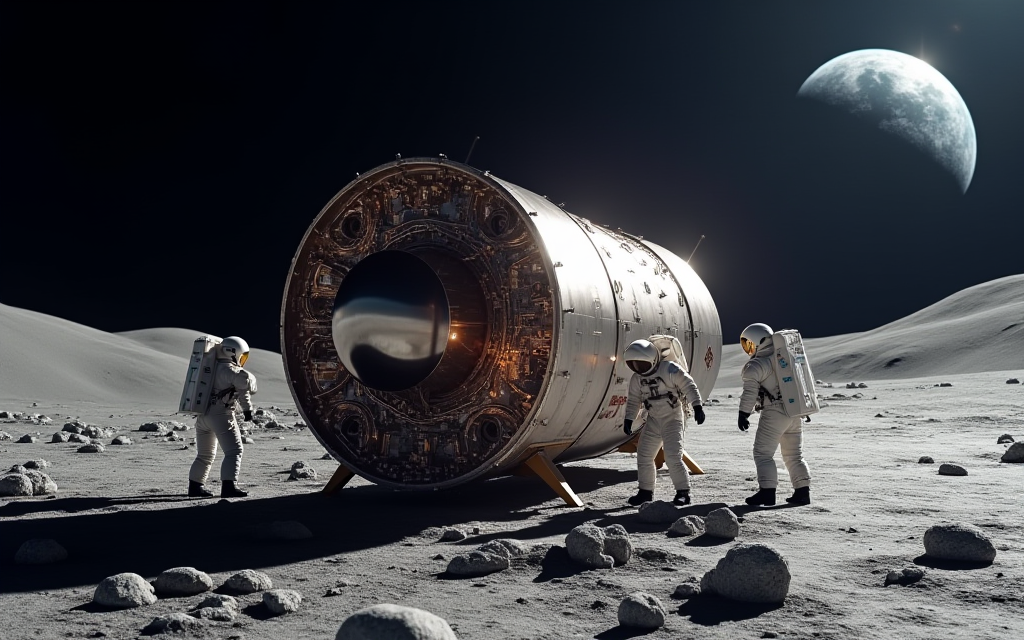
NASA Seeks Industry Partners to Build First Nuclear Reactor on the Moon
NASA is seeking industry partners to design and build the first nuclear reactor for the Moon, aiming to provide reliable power for lunar habitats and future Mars missions. The fission surface power system must generate at least 40 kilowatts and operate for a decade without refueling, overcoming the limitations of solar energy during the lunar night. This partnership initiative builds on previous research and supports the Artemis program’s goal of sustainable lunar exploration.
NASA Calls for Industry Partners to Power Lunar Future
NASA is taking a major step toward establishing a sustainable human presence on the Moon by seeking industry partners to design and build the first nuclear reactor for lunar surface operations. The agency’s request, announced in November 2026, aims to develop a fission surface power system that can operate reliably in the harsh lunar environment, providing continuous energy for habitats, rovers, and scientific experiments.
Why Nuclear Power for the Moon?
Solar power, while abundant in space, is unreliable during the two-week lunar night and in permanently shadowed regions. Nuclear fission offers a compact, long-lasting, and resilient energy source that can support astronauts and infrastructure regardless of sunlight. NASA envisions a reactor capable of generating at least 40 kilowatts of electrical power—enough to power dozens of homes on Earth—for up to a decade without refueling. This capability is critical for the Artemis program’s goal of long-term lunar exploration and eventual missions to Mars.
Key Requirements and Challenges
The reactor must be lightweight enough for launch, robust enough to withstand the extreme temperatures and vacuum of space, and designed for autonomous operation. Safety is paramount: the system must remain subcritical until it reaches the Moon and be capable of shutting down automatically. NASA is also emphasizing the need for a design that can be tested on Earth and then safely integrated with lunar landers.
Partnerships and Timeline
NASA is inviting U.S. companies to submit proposals for the design, development, and demonstration of a flight-ready reactor. The agency plans to award multiple contracts for preliminary designs, with the goal of selecting a final design by the early 2030s. This initiative builds on prior research, including the Kilopower project, which successfully demonstrated a small fission reactor on Earth. The partnership model encourages innovation and cost-sharing, leveraging commercial expertise to accelerate development.
Broader Implications for Space Exploration
Beyond the Moon, nuclear power systems will be essential for future crewed missions to Mars, where solar power is even less viable. Reliable energy enables in-situ resource utilization, such as extracting water ice for propellant and life support, and supports advanced manufacturing and construction on other worlds. NASA’s push for lunar nuclear power signals a new era of space infrastructure, where industry and government collaborate to create sustainable off-world outposts.
Conclusion
NASA’s call for partners marks a pivotal moment in space technology. By harnessing nuclear energy, the agency aims to unlock the Moon’s potential as a stepping stone to the solar system. As proposals come in, the world watches to see which companies will help light the way for humanity’s return to the lunar surface—and beyond.
