

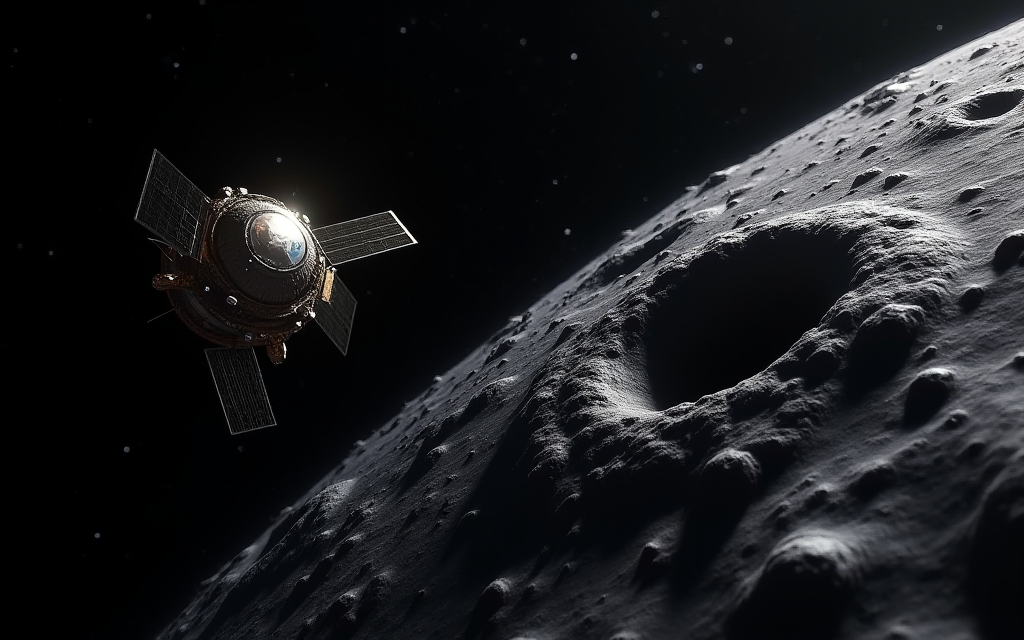
Hera Spacecraft Reaches Asteroid Crash Site to Study DART Impact Aftermath
The European Space Agency's Hera spacecraft has arrived at the asteroid Dimorphos to study the aftermath of NASA's DART impact, which successfully altered the asteroid's orbit in 2022. Hera will measure Dimorphos's mass and examine the crater to understand the collision's effects, providing crucial data for future planetary defense efforts against hazardous asteroids.
Hera Arrives at Dimorphos to Assess DART’s Cosmic Crash
Four years after NASA’s DART spacecraft intentionally slammed into the asteroid Dimorphos, the European Space Agency’s (ESA) Hera mission has arrived at the crash site to investigate the aftermath. The groundbreaking planetary defense test, which aimed to alter the asteroid’s orbit, has left scientists with crucial questions about the impact’s effects.
Hera, described by principal investigator Patrick Michel as “a sort of Inspector Columbo going back to the crash scene,” will spend the next year studying Dimorphos and its larger companion Didymos. The first images from the rendezvous are expected to be released later today.
Background: The DART Mission and Its Historic Impact
In 2022, NASA’s DART (Double Asteroid Redirection Test) spacecraft deliberately collided with Dimorphos, a 150-meter-wide moonlet orbiting the 730-meter-wide asteroid Didymos. Traveling at 22,000 km/h (14,000 mph), the impact was powerful enough to create a debris trail stretching 10,000 km into space, observed by telescopes including the Hubble Space Telescope.
The collision successfully changed Dimorphos’s orbital period around Didymos, reducing it by about 33 minutes—from 11 hours and 55 minutes to approximately 11 hours and 22 minutes. This proved that kinetic impact could be a viable method for deflecting hazardous asteroids. However, much remains unknown about the collision’s immediate effects.
Hera’s Mission: Unraveling the Impact’s Secrets
Hera is equipped with a suite of instruments and two shoebox-sized CubeSats that will conduct close-up studies of the impact site, eventually landing on the asteroid. A key objective is to measure Dimorphos’s mass, which will help scientists quantify how effective the DART shove was.
“The impact could have left a crater—and if it is the case, we need to understand the size and the depth. Or [the impact] may have entirely reshaped the asteroid,” Michel explained. Understanding these details is vital for planning future planetary defense missions.
“It would help us to predict what would happen if we had to hit another asteroid,” said Prof Simon Green, a planetary scientist on Hera’s science team. “We [could] measure its properties and say: ‘Well, we need this mass of spacecraft, travelling at this speed, this early, in order to deflect it enough so that it misses the Earth.'”
The Broader Threat of Asteroids and Future Missions
Asteroids pose a significant threat to Earth. While the largest ones, over a kilometer across, could cause global devastation, medium-sized asteroids like Dimorphos could wipe out an entire city. “We all know what happened to the dinosaurs, right? And we don’t want that to happen to us,” said Carolyn Ernst of Johns Hopkins Applied Physics Laboratory, who works on both DART and Hera.
While the biggest asteroids have been identified and none are currently on a collision course with Earth, there is a size range in the middle where many objects remain undiscovered. “If we can find out about that and know about that, well, we sure as heck would want to try to stop that,” Ernst added.
Future missions are already planned to address this gap. NASA’s NEO Surveyor space telescope, launching in 2027, will hunt for potentially hazardous asteroids. Additionally, two spacecraft—NASA’s OSIRIS-APEX and the ESA/JAXA joint mission RAMSES—will visit the asteroid Apophis when it makes a close flyby of Earth in 2029.
Hera’s findings will not only shed light on the DART impact but also inform strategies for protecting our planet from future asteroid threats.
