

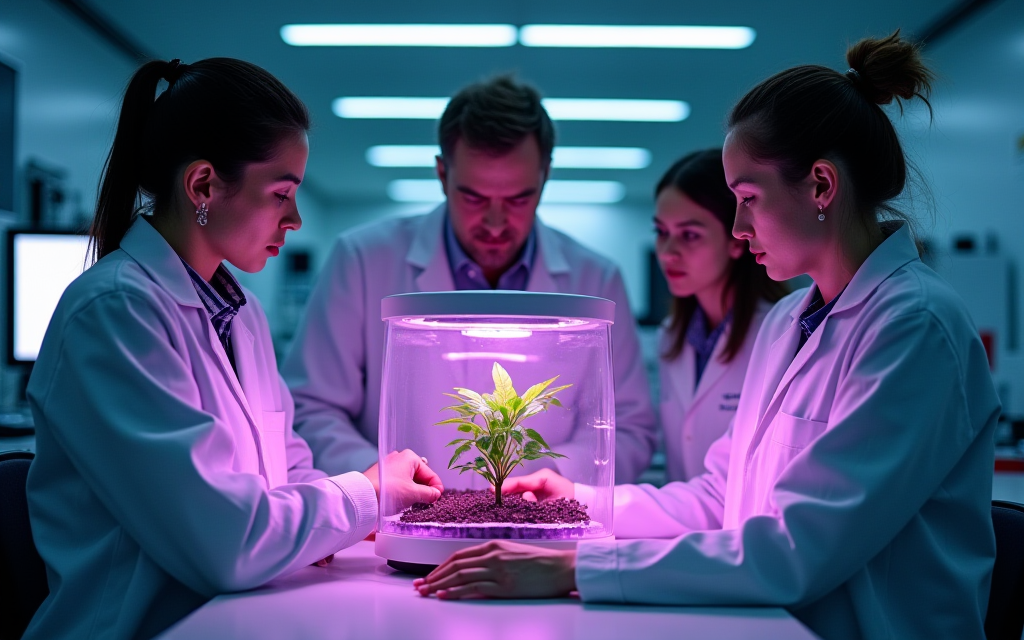
NASA’s NG-25 Mission to Launch Pioneering Space Crops Research
NASA's NG-25 mission will launch from Wallops Flight Facility carrying experiments to study plant growth in space. The research aims to advance space agriculture for future missions to the Moon and Mars, testing systems for food production in microgravity.
NASA’s NG-25 Mission to Launch Pioneering Space Crops Research
CAPE CANAVERAL, Fla. — NASA’s Northrop Grumman NG-25 mission is set to launch from Wallops Flight Facility in Virginia, carrying a suite of experiments aimed at advancing space crop research, the agency announced. The mission, scheduled to lift off aboard a Cygnus spacecraft atop an Antares rocket, will deliver critical scientific payloads to the International Space Station (ISS) to study plant growth in microgravity.
The NG-25 mission, part of NASA’s Commercial Resupply Services program, will carry dozens of experiments, including the Advanced Plant Habitat (APH) and the Veggie facility, which are designed to test the feasibility of growing food in space. The research is pivotal for long-duration missions to the Moon and Mars, where astronauts will need to rely on sustainable food sources.
Key Experiments and Objectives
The mission’s primary payload is a set of biological and physical science investigations focused on space agriculture. According to NASA, the experiments will examine how plants respond to the spaceflight environment, including altered gravity, radiation, and limited resources.
- Plant Growth in Microgravity: The APH will study the growth of Arabidopsis and dwarf wheat under controlled conditions, assessing yield and nutritional content.
- Root Zone Microbiology: Researchers will investigate how beneficial microbes interact with plant roots in space, potentially improving nutrient uptake.
- Water and Nutrient Delivery: New systems for efficient water and nutrient delivery will be tested to optimize plant growth in confined spaces.
These experiments are expected to provide data that could lead to more efficient life support systems for future space habitats.
Collaboration and Commercial Partners
The NG-25 mission is a collaborative effort between NASA and Northrop Grumman, with scientific instruments developed by universities and research institutions across the United States. The Cygnus spacecraft will also carry supplies and equipment for the ISS crew, including food, water, and spare parts.
Dr. Kendra Cook, NASA’s project scientist for the mission, emphasized the importance of the research. “Understanding how plants grow in space is essential for sustaining human life beyond Earth,” she said. “The NG-25 mission will bring us closer to that goal.”
Launch Details and Timeline
The launch is targeted for no earlier than 5:30 p.m. EST on December 3, 2026, from Pad 0A at the Mid-Atlantic Regional Spaceport. The Cygnus spacecraft is expected to arrive at the ISS on December 6, where it will be captured by the station’s robotic arm and berthed to the Unity module.
After a planned stay of about three months, the spacecraft will depart the ISS and dispose of waste before burning up in Earth’s atmosphere. The scientific data collected during the mission will be analyzed by researchers on the ground, contributing to NASA’s long-term goal of establishing a sustainable presence on the Moon and Mars.
This mission marks the 25th commercial resupply flight for Northrop Grumman and the 19th under NASA’s CRS-2 contract.