

Trump’s China Summit with Putin and Xi: Spectacle Over Substance
President Trump's historic trilateral summit with Putin and Xi in China was high on spectacle but low on substance, yielding only vague commitments and no concrete agreements. While the imagery of the three leaders together dominated headlines, back home lawmakers criticized the meeting as a photo opportunity that failed to address key issues. The joint communique offered little beyond rhetoric, and analysts suggest the summit may be quickly forgotten.
A Historic Trilateral Meeting
In a historic first, US President Donald Trump met with Russian President Vladimir Putin and Chinese President Xi Jinping on the sidelines of the Asia-Pacific Economic Cooperation (APEC) summit in Shenzhen, China, on 19 November 2026. The trilateral meeting, billed by some as a modern-day “Yalta 2.0,” was heavy on pomp and ceremony but light on concrete outcomes.
The Optics of Power
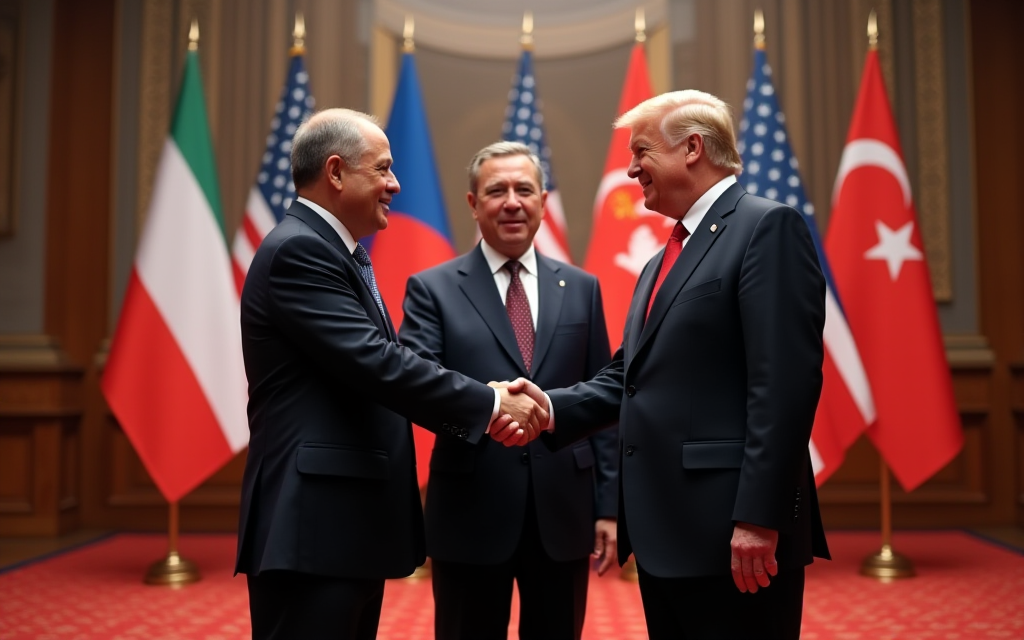
The images of the three leaders sitting together, smiling and shaking hands, may be the most lasting impression of the summit. For Trump, who has been bruised by his party’s midterm election losses, the global spotlight and the pageantry of the event seemed to be the primary objective. He later touted the “fanfare, the beauty, the pageantry, the thousands of people” as evidence of success.
However, beyond the visuals, the meeting produced little in terms of substantive agreements. A joint communique released after the talks offered vague commitments to “strategic stability and international security” and acknowledged that nuclear war “must never be fought,” but lacked specific actions or timelines.
Reactions and Analysis
While China and Russia were quick to present a united front, the White House remained unusually silent, with Trump promising a press conference later. Analysts noted that the summit was more about appearances than achievements. “In general, it’s good for the leaders of the major global players to come together in various formats, even if the results appear to be modest at best,” said David Firestein of the Bush Foundation for US-China Relations.
Back in Washington, reactions were mixed. Republican Senator John Curtis expressed concern over the friendly tone with adversaries, stating, “Vladimir Putin and Xi Jinping are not our friends.” Democratic senators criticized the meeting as a photo opportunity that undermined American security.
What Was Actually Agreed?
The joint communique included a line about boosting “the production and supply of refined petroleum products,” likely aimed at Russia, and criticized the International Criminal Court—a stance that aligns with US interests. However, these points were overshadowed by the lack of progress on major issues such as Ukraine, trade, and human rights.
Trump’s friendly gestures, including calling Putin a “friend” and praising his relationship with Xi, drew criticism from lawmakers who warned against legitimizing authoritarian leaders. The summit, while visually striking, may be quickly forgotten as a diplomatic breakthrough that never materialized.
The Aftermath and Implications
As Trump returns to a politically charged environment in Washington, the summit’s lack of tangible results may reinforce perceptions that his foreign policy is more about showmanship than strategy. With midterm elections looming, the president’s overseas trip may not provide the domestic boost he hoped for.
Ultimately, the trilateral meeting will likely be remembered for its spectacle rather than its substance—a moment of great power theater that did little to address the world’s pressing challenges.
