

Spain Election 2026: Sánchez, Feijóo Hold Final Rallies as Polls Show Tight Race
Spain's Prime Minister Pedro Sánchez and conservative rival Alberto Núñez Feijóo held final rallies on Friday ahead of Sunday's general election. Sánchez expressed confidence despite polls showing a narrow lead for Feijóo's People's Party. The campaign has been dominated by issues of housing, corruption, and immigration, with the far-right Vox party hoping to make significant gains. Nearly 39 million Spaniards are eligible to vote in an election that could shift one of Europe's few left-wing governments to the right.
Spain’s Party Leaders Make Final Push Before Sunday’s Election
MADRID, Spain — Spain’s main political leaders held their final campaign rallies on Friday, making last-ditch appeals to voters ahead of Sunday’s general election, with polls indicating a closely contested race between the ruling Socialists and the conservative opposition.
Prime Minister Pedro Sánchez, leader of the Spanish Socialist Workers’ Party (PSOE), expressed confidence in defying the polls, telling supporters in Madrid, “I cannot imagine us losing.” He accused his conservative rival, Alberto Núñez Feijóo of the People’s Party (PP), of planning to govern with the far-right Vox party.
Feijóo, whose PP holds a narrow lead in most surveys, campaigned in Barcelona and Seville, promising a new era of “truth, decency and good governance.” He criticized Sánchez for avoiding questions on corruption, rail disasters, immigration and national debt.
Key Issues and Campaign Dynamics
Housing Crisis and Scandals Dominate Debate
The final day of campaigning followed a heated four-way televised debate on Thursday that highlighted Spain’s polarized political landscape. All leaders proposed solutions to the housing crisis, with Feijóo pledging to build one million homes over four years and Sánchez arguing that housing should be a right, not a speculative commodity.
The debate also exposed personal tensions. Feijóo accused the left of staying silent during a flood disaster in Valencia, using the term “calladita” (a diminutive that can be condescending toward women), which Sánchez condemned as sexist. Feijóo later sought to clarify his remarks.
Vox’s Rising Influence
Santiago Abascal, leader of the anti-immigration Vox party, held a rally in a bullring in Valencia, where he accused Sánchez’s government of having “betrayed” Spaniards. Vox hopes to nearly double its seats from the 33 won in the previous election. The party advocates policies such as “national priority” for welfare and “remigration” for foreigners deemed non-contributory.
Some attendees at the Vox rally expressed support for the party’s immigration stance. First-time voter Lledó, 18, cited the summer incident in Ceuta, where over 70,000 migrants crossed from Morocco, as evidence that Sánchez cannot control borders. A small section of the crowd chanted “Viva Franco,” referencing the late dictator.
What’s at Stake
Nearly 39 million Spaniards are eligible to vote, and turnout is expected to be high. The election could see one of Europe’s few left-wing governments shift to the right, with potential implications for the continent’s political balance. Feijóo has insisted he wants to govern with a majority and has not discussed ministerial positions with Vox, though he has relied on their support in several regions.
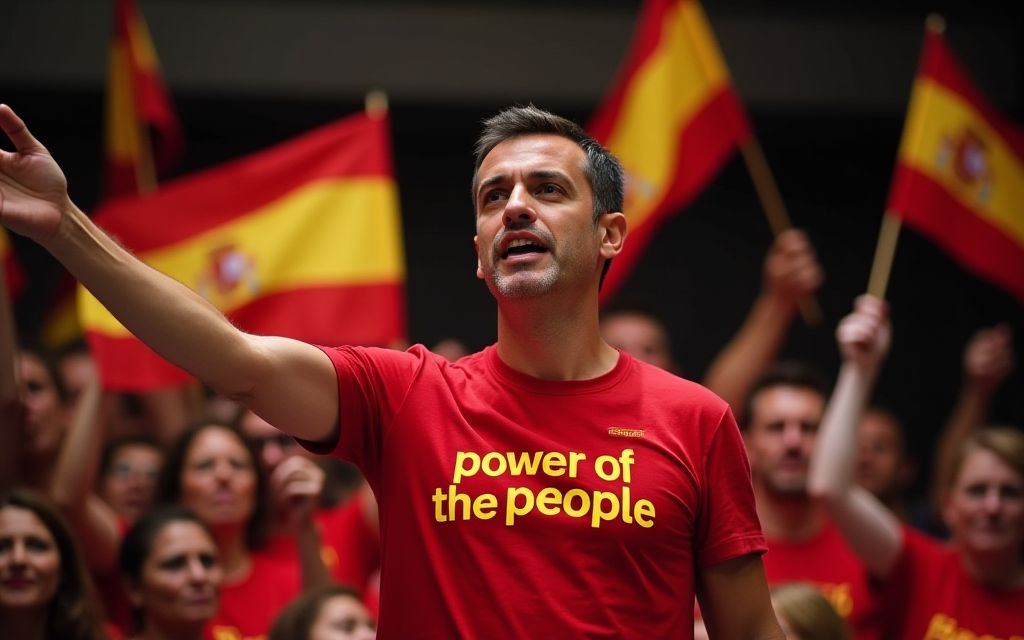
Sánchez, campaigning in a red T-shirt reading “power of the people,” was joined by his wife, Begoña Gómez, and praised the left-wing coalition Frente Amplio (The Broad Front), led by Ada Colau. Colau, a former Barcelona mayor, vowed to form another “progressive government” and told supporters, “We will not remain silent, we will win.”
As the campaign draws to a close, the outcome remains uncertain, with both sides mobilizing supporters in a final bid for votes.