

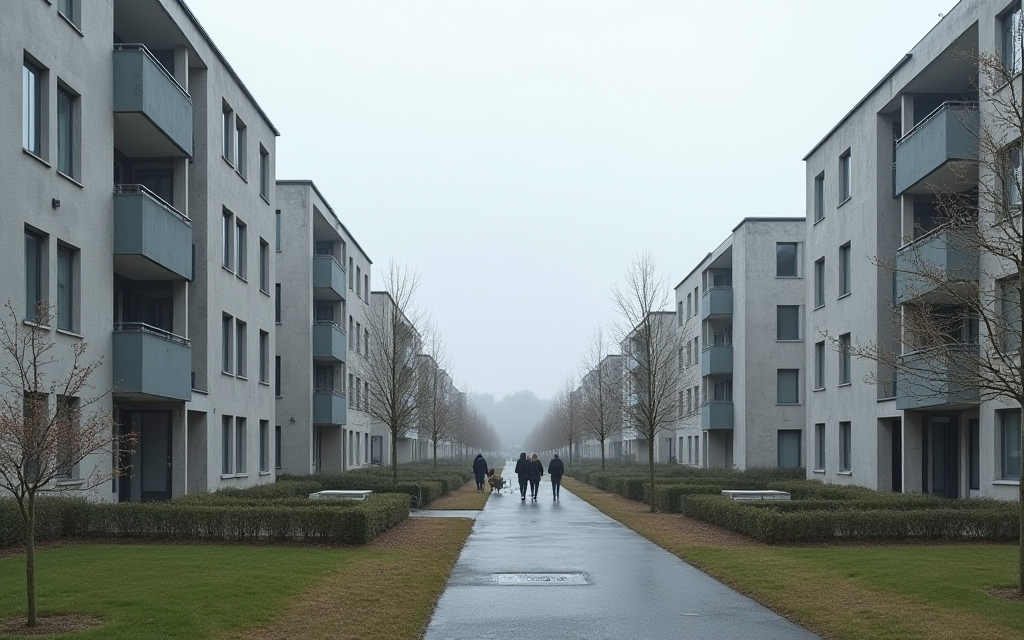
Denmark’s Supreme Court Upholds ‘Ghetto Law’ Evictions of Non-Western Residents
Denmark's Supreme Court has upheld the controversial 'ghetto law,' allowing the eviction of non-Western residents from the Mjolnerparken housing estate. The ruling affirms a policy aimed at promoting integration by relocating minorities from disadvantaged areas, but critics argue it is discriminatory and violates human rights. The decision has significant implications for affected families and the broader debate on integration in Denmark.
Denmark’s Supreme Court Upholds Controversial ‘Ghetto Law’
Denmark’s Supreme Court has ruled in favor of the government’s so-called ‘ghetto law,’ allowing the eviction of ‘non-Western’ tenants from the Mjolnerparken housing estate. The decision, announced on November 24, 2026, affirms a policy that permits the relocation of residents from areas with high concentrations of ethnic minorities, which the government argues will promote integration.
The case was brought by tenants who challenged their evictions under the law, claiming discrimination. The Supreme Court’s ruling effectively ends their legal battle, setting a precedent for similar cases across the country.
Background of the ‘Ghetto Law’
Denmark’s ‘ghetto law,’ officially known as the ‘Parallel Society Act,’ was introduced in 2018. It targets neighborhoods with a high percentage of residents of ‘non-Western’ origin, defined as immigrants and their descendants from countries outside Europe, North America, and other Western nations. The law allows the government to reduce the proportion of social housing in these areas and to relocate residents.
Critics argue that the law is discriminatory and stigmatizes minority communities. The term ‘ghetto’ itself is controversial, and many see the policy as a tool for forced assimilation. The government, however, maintains that the law is necessary to break cycles of segregation and improve integration.
Impact on Mjolnerparken Residents
The Mjolnerparken housing estate in Copenhagen has been a focal point of the controversy. Many residents facing eviction have lived there for decades and have strong community ties. The evictions have caused significant distress, with families forced to leave their homes and support networks.
Under the law, residents are offered alternative housing, but many argue that the replacements are inadequate or located in areas with fewer opportunities. The psychological and social toll on affected families has been substantial.
Legal and Human Rights Concerns
Human rights organizations, including the Danish Institute for Human Rights, have criticized the law for violating international human rights standards. They argue that the law discriminates based on ethnicity and origin, contravening the European Convention on Human Rights.
The Supreme Court’s decision, however, found that the law does not violate the Danish Constitution or international obligations. The court reasoned that the law’s objective of promoting integration is legitimate and that the means employed are proportionate.
Despite the ruling, the debate over the law’s fairness and effectiveness continues. Opponents vow to continue fighting for the rights of affected residents, while supporters see the decision as a validation of Denmark’s integration policies.
